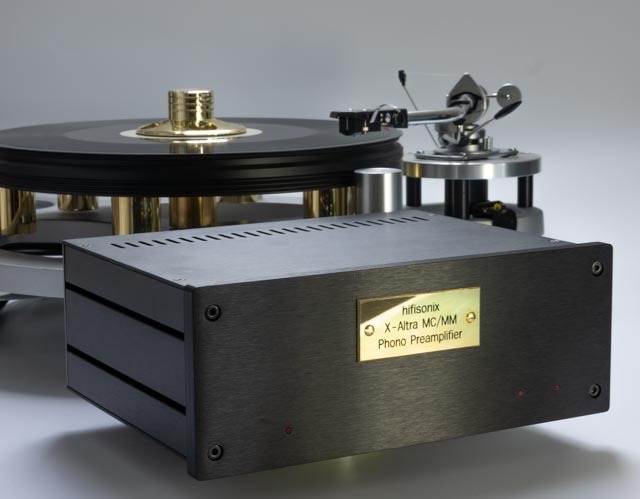
The X-Altra MC/MM phono preamp, whether bought as a completed unit or DIY built, delivers the ultimate performance with respect to noise, overload, and RIAA conformance, placing it among the very best available anywhere at any price.
In 2021, the design was featured in audioXpress, a leading audio industry publication based in the US. Part 1 and part 2 of the article can be downloaded from the audioXpress website here: –
If you have any questions, or require technical support with your build, contact me via the comments section below or email me at bonsai(at)hifisonix.com (replace the (at) with @)
There is also a diyAudio thread about this preamplifier here :-
The PCB set offered to build this preamp is designed to work with the Modushop Galaxy Maggiorato GX287 230 x 170 mm 10mm front panel housing. The main analog board with the black, gold-flashed, and silk-screened rear panel attached, slides into the housing from the rear and is then held in place by 4 x M4 x 10mm retaining screws on the rear panel.
The table below allows you to get an idea of how noisy a MC preamp is given the cartridge coil resistance and the amplifier input referred noise. Once you have the number off the table, use the following formula to calculate the S/N Ratio: 20 log [(Rdg*144)/Cartoutput] where Rdg is the reading from the table and Cartoutput is the MC cartridge output in Volts. It is clear from this table that the X-Altra MC/MM is in a league of its own in terms of thermal noise (and overload capability).
For the X-Altra, the measured equivalent input thermal noise resistance is 1.4 Ohms, so its ABOVE the 2 Ohm row, but we will use the 2 Ohm row since it is close enough. The figures in RED show the expected X-Altra preamp S/N ratio for a 200uV output cartridge. The ‘A’ weighted figures will be about 4 dB better than those shown.
Some photos of the completed preamplifier, along with my Michel Gyro SE are shown below.
This power amp design is based on the sx-Amplifier topology, but with the TIS and output stage re-configured for class AB operation, enabling it to deliver 100 W into 8 Ohms. I have kept the design very simple, retaining the CFA topology, providing a very wide -3 dB bandwidth of 570 kHz, high slew rates (140 V/us) and low distortion. Since it was first published in 2012, about 400 board sets have been sold world-wide (the sister sx and kx2 class A current feedback amplifiers have had combined sales of around 450 board sets). The nx-Amplifier is a perfect introduction to current feedback amplifiers, showcasing the topologies legendary open midrange, fantastic bass performance and delicate, silky top end.
Amplifier write up with circuit description, wiring diagram and construction details:- The-Ovation-nx-Amplifier-V2.10 (updated November 2014 to V2.0 PCB’s incorporating all feedback and updates). Please IGNORE the BOM in the build document and instead use this latest BOM, released in December 2021 that uses currently available semiconductors nx-Amp BOM December 2021
You can get a complete set of double sided THP Gold Plated V2.0 PCB’s for the above from Jim’s Audio on ebay here:
1. The nx&sx-Amp PSU board is a simple unregulated PSU board with no muting, output short circuit or DC offset protection. The only protection is the amplifier module fuses
2. . The nx-Amp_PSU+Protection board option couples an unregulated PSU with speaker muting, output short circuit protection and DC offset detection protection.
See the nx-Amplifier article above for details. If you have any questions, feel free to post your questions up here.
If you are a manufacturer, kit supplier or DIY shop, and you want to use the designs (circuit or PCBs) you need to contact me.
I’d be happy to hear your comments/feedback.
Notes and Addendums
1. Please note, there in no R2 on the PSU +Protect PCB or on the schematic although the BOM calls for it.
About 150 sx-Amplifier PCB sets have been sold, with most of those going on to be built. As you can read about in the PDF below, my class A journey started off after listening to an ancient Musical Fidelity A1 that I repaired for a friend while living in Taiwan. I’ve had many emails from sx-Amp builders who have loved the sound, despite this being a very simple and not particularly low distortion amplifier. If you are new to DIY audio, this is probably a good as any place to start.
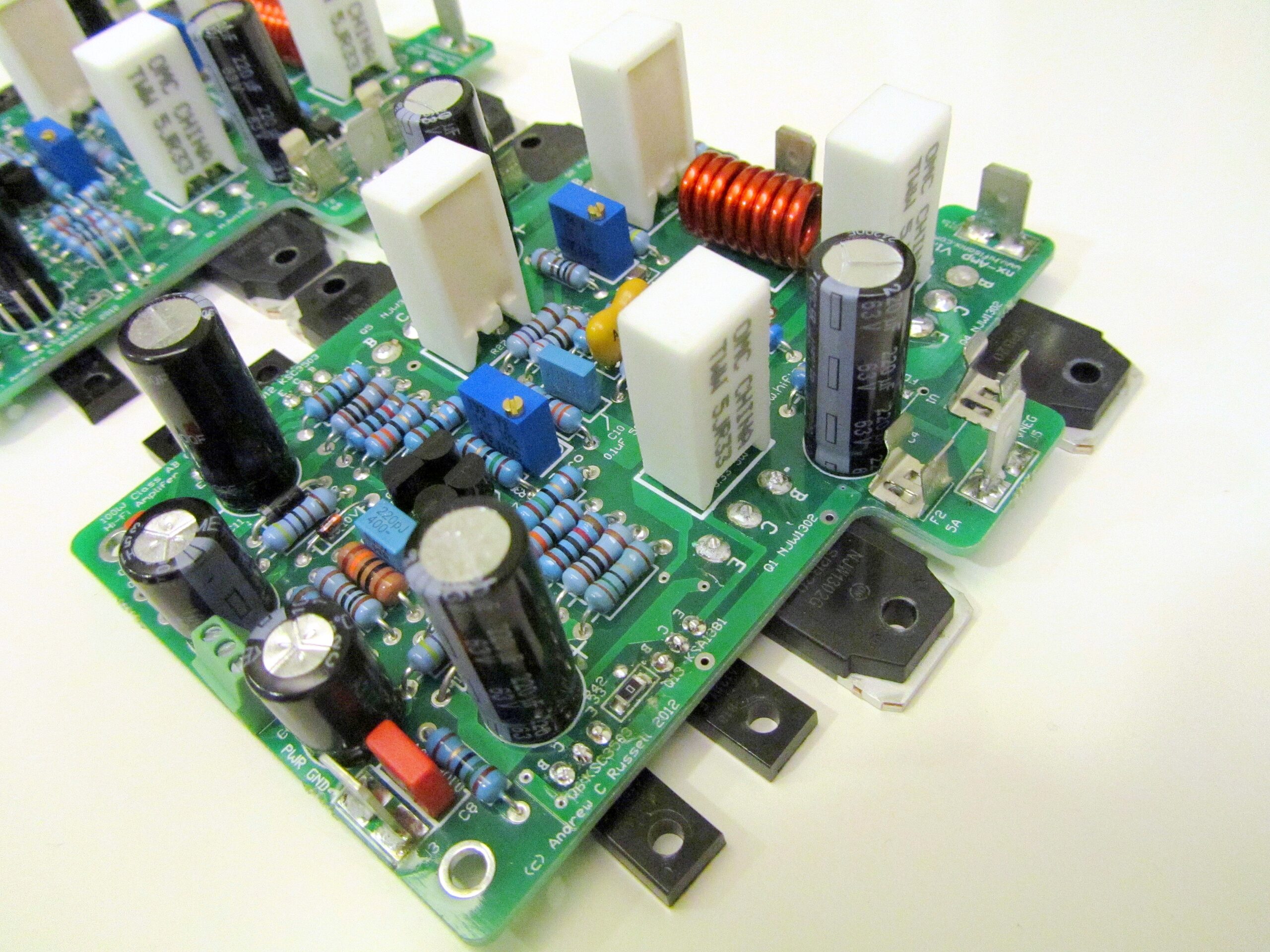
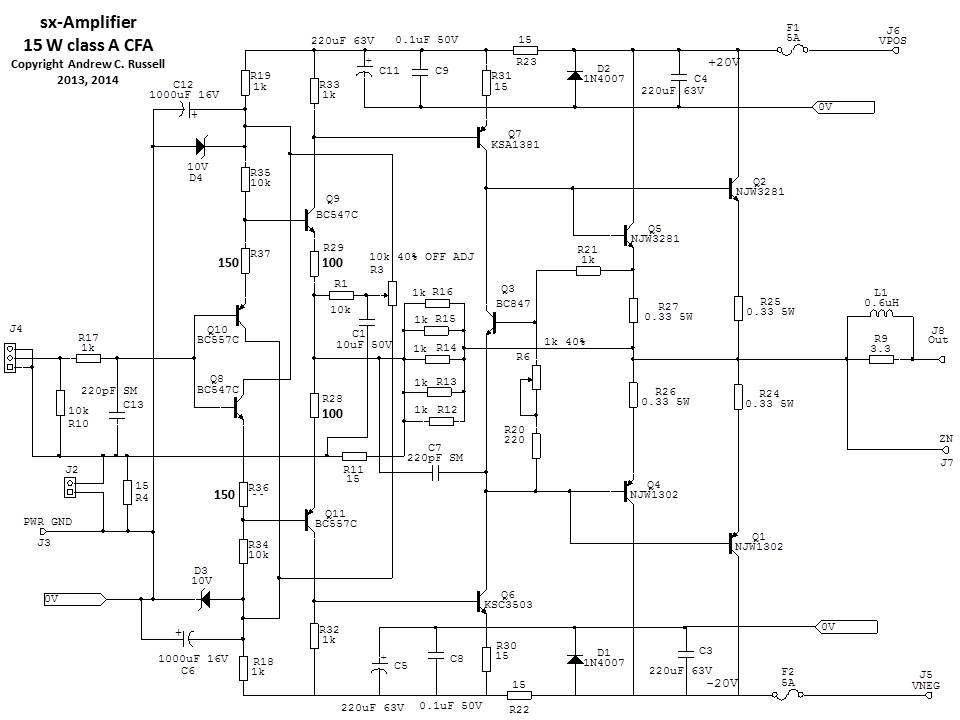
The hifisonix sx-Amplifier is a low component count current feedback topology (CFA) design that delivers 15W RMS in class A into an 8 Ohm load (about 25W peak in class A) and around 25W RMS into 4 Ohms in class AB mode. The design uses readily available components, achieves very wide bandwidth, along with fast rise and fall times. Distortion is low compared to competing designs (e.g. JLH’s 10 Watter from 1969, or Jean Hiraga’s 20 W class A), thanks to the availability of modern bipolar devices, and the use of LTSpice to optimize the design.
Here is an Excel file that contains the BOM lists, including Mouser part numbers for the sx-Amplifier (covers both the double sided THP PCB version ABOVE and the new single sided PCB version discussed ): –
I have had a lot of requests for PCB’s and/or people indicating they would like to etch their own boards. To support these requests, I’ve created a second layout that is singled sided and more amenable to home etching. (The PDF file scale is 1:1):
Pop Alexandru, also known as Alex MM on diyAudio.com has also kindly produced a set of single sided PDF layouts below that closely follow my DS THP version. He has produced both mirrored and non-mirrored versions. His boards are neater than mine! Thank you Alex!
Note: there are no single sided PSU layouts. If you build the sx-Amp using single sided PCB’s, and your own PSU, do not forget to fit your finished amplifier with a Zobel network of 0.1uF and 10 Ohms in series from J7 to the 0V star ground on your PSU. If using the DS THP PSU board from Jim’s Audio, the Zobel network is located on the PSU board. Just follow the wiring up instructions in the writeup.
Note: the component numbers and BOM list are all the same for the single sided PCB but with the following changes: J2 is removed. C2 becomes a 16V 10uF through hole capacitor (C1 remains a 1206 10uF 50V MLCC SMD device); Q3 becomes a BC547C.
The sx-Amplifier: A 15 W Current Feedback Class A Amplifier
Jean Hiraga’s 20 W class A design became something of a cult amplifier in the 1980s in the audio community and constructors from Europe, Australia, Japan and the USA praised it’s sonic performance. In that design, Hiraga used a much simplified (I’d call it sparse, or ‘stripped down’) current feedback amplifier (CFA) topology and low feedback to create an amplifier that was described somewhere as sounding ‘liquid’ and ‘tube-like’. Hiraga has always been noted for his minimalist, idiosyncratic designs, and comments about the sonics aside, I was attracted to the simplicity – only 8 transistors in the original and a handful of discrete components (excluding the power supply of course) for a complete class A amplifier. Distortion was by any standards very high, topping out at about 1.8% at the rated power into 8 Ω, although he seems to have indicated it was of the ‘good variety’ due to its harmonic structure. However, Hiraga’s amplifier (rated at 20 Watts per channel into 8 Ω) was the product of 1980’s know-how and device technology. I found myself wondering what I could cook up with today’s components and the insights afforded by circuit simulation tools that were unavailable back in the early eighties. I did quite a bit of research on Geoff Moss’s excellent ‘the class A amplifer site’ (tcaas) and Rod Elliot’s ESP site and the Death of Zen (DoZ) amplifier, modelled after JLH’s classic 10-Watt design from 1969. Compared to the 1980s, we now have some really good power transistors, and there is no shortage of cheap good quality small signal devices either, other than the ultra-low noise small signal bipolar and JFETs from Toshiba in Japan of course, which are now discontinued.
Looking at the reprint of JLH’s original 1969 10 W class A design, it is immediately apparent that the distortion vs. frequency graph at 9 W output is flat all the way out to the measurement limit, which was beyond 20 kHz. In a conventional Voltage Control Amplifier (VCA) class AB topology, when driving a load that causes the output stage to exit the very narrow class A bias region (ideally set at .026/Retot where Retot is the total output transistor emitter degeneration resistance including the reflected base resistance and typically ranging from 0.1 Ω through to 0.47 Ω), distortion kinks upwards at 40 dB/decade, with the kink point a few hundred Hz up to a few kHz. Distortion increases at 40 dB/decade, arising from the fact that the amplifier loop gain beyond the -3 dB point is decreasing at -20 dB/decade, while the THD contribution doubles with every octave because with every doubling of frequency, there is a doubling of cross over events, and hence distortion.
The shape of the distortion curve over frequency tells us something about the nature of class AB amplifiers when required to move from their class A region into class B – feedback can only do so much to reduce the distortion, and if that feedback (loop gain) is already decreasing at 20 dB/decade within the audio band, you simply have to accept the uptick in the distortion vs. frequency plot. JLH’s output stage design was class A of course, and so did not have to contend with crossover distortion, and this is the fundamental advantage of class A over class AB. The major distortion component in any competently designed class AB amplifier is the crossover distortion, and if that can be removed as a factor, there are significant performance and sound benefits to be had. At low frequencies (i.e. below about 30 Hz), the distortion on JLH’s amp rose rapidly because of the electrolytic coupling cap between the output and the speaker. Later enhancements of his design did away with the output coupling capacitor at the expense of a split rail supply and output offset adjustment.
The sx-Amplifier is a thoroughly modern take on the class A genre that employs CFA topology, 30 MHz Ft output devices and features a – 3dB bandwidth of 540 kHz, along with slew rates of 140 V/us. This is a very smooth sounding amplifier, suited to jazz, classical and acoustic material in general which should be married to speakers with efficiencies of 92 dB/W or better if one is after realistic concert hall sound levels – however, I used mine whilst in Asia with my B&W 703’s, which are rated at 89 dB/W, in a modest sized listening space and found that satisfactory volume levels were easily attainable.
In the design you see here, I had the transformer specially wound by ‘PowerStar’ in Taiwan and it features a screen and GOSS band for the best noise performance. Careful attention to layout and wiring have resulted in an exceptionally quiet amplifier. What does it sound like? As mentioned earlier, this amplifier is best suited to classical, jazz and acoustic material – because of the limited power on tap, its not really suited to rock or material that demands high power.
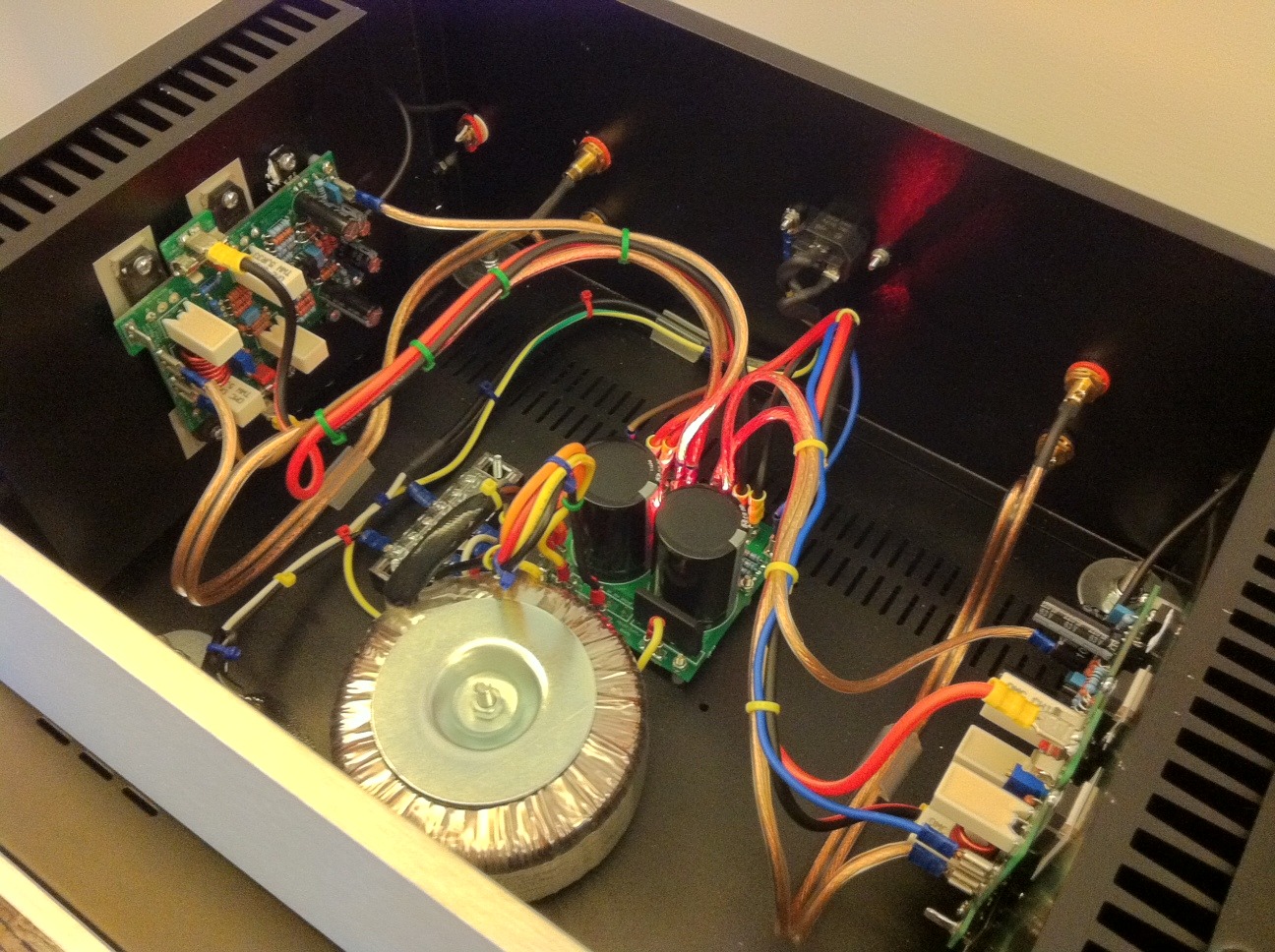
The photograph below is of the second build I did of the sx-Amp.
This is the sx-Amp I ended up using up until the kx2-Amp arrived some 10 years later in 2022. Incidentally, I built one of the nx-Amplifiers into a similar chassis.
I have to admit I started this project with some apprehension about what a small amp would sound like – especially since I am used to listening to a big amp (250 W per channel which you can read about here Ovation 250 Amplifier and a 180 Watter called the e-Amp ). Why design a 15 W class A amplifier, and especially one that is decidedly minimalist, after two big, complex, powerful, high performance ones? Well, there are a few reasons. Firstly, designing single digit, or sub 1 ppm distortion amplifiers can provide a rewarding intellectual experience, if only to later be thwarted by practical execution that impacts both performance and build aesthetics. Secondly, reductions in distortion below about 0.5% offer little orno further improvements in the perceived sound quality of an amplifier in controlled testing and there is a lot of academic material in support of this contention. Anecdotally, Nelson Pass has built a name for himself with class A amplifiers that for the most part never see the south side of 0.1%, and yet are highly rated by the cognoscenti. What about power levels? Big amplifiers sound wonderfully at ease with themselves – they are unflappable and handle music dynamics well. Low power amplifiers, like the sx-Amp under discussion here, really need to offer something unique to justify the effort in construction, and exploring this territory is the 3rd reason for undertaking this project: is there a magic class A sound that makes building something like this worth it?
Speakers are notoriously non-linear often 2 to 3 times higher than the 0.5% I quoted above. Now, none of this can serve as an excuse for badly designed, sloppily engineered, high distortion amplifiers. We know that the ear is much more sensitive to some types of distortion (crossover for example) and to higher order harmonic content in particular. If these things are taken as considered inputs into the design process, we then have some latitude in design philosophy: Challenging, all out, ultra-low distortion designs, or something a little less demanding, but that ticks all of the right boxes given our knowledge about how the ear/brain system works and therefore sounds good because we avoid the major pitfalls, and is FUN TO BUILD! This is exactly where the sx-Amp is positioned.
Once testing and set up were completed, I was very excited to hear what this thing could do. For initial listening I chose a few classical CD’s – a Lexus classical CD (freebie), Julian Bream ‘The Ultimate Guitar Collection’, a wonderful ‘LSO Live’ sampler from Hi-Fi News, A Philips Sampler from the 1990’s ‘Introducing Mozart’, followed by two jazz CD’s: Michel Petrucciani’s ‘Both Worlds’ and ‘Time Out’ from The Dave Brubeck Quartet.
Pictured above is the very first sx-Amplifier I build in 2012 while living in Taiwan
I’ve had a Hi-Fi News LSO sampler for about seven or eight years. The tracks date from performances made between 1999 through 2002. All tracks superbly recorded with tremendous space (holographic) and dynamic range. The sx-Amp produced a wonderful three dimensional sound stage that extended well beyond the speakers, very deep and layered front to back. If you are ever looking for a classical demo CD – this has to be it! To be sure, a big part of this is the quality of the recordings, but no doubt the class A magic also played an important role in what I was hearing. Strings have that ‘bite’ to them in their lower registers and the top end shimmers marvelously; brass has the leading edge snap followed by the tizz that you only get from a really good recording played through a sympathetic signal chain. The top end on this amplifier is very beguiling without any hint of harshness and the overriding sensation is one of smoothness and relaxed detachment. The scale on the Brahm’s piece (‘Denn Alles Fleisch Est Wie Gras’) was very well reproduced which was surprising to me given the fact that only 15 W was on hand.
Up next was a double CD collection of Julian Bream recordings covering the four decades from 1959 through 1982. Some of the early recordings are a little noisy (tape hiss) but the sound is very spacey and the notes wonderfully rounded and resonant. My favourite is disc 2, which was recorded in 1982/83 and consists entirely of solo guitar and lute pieces. Here again, the sound staging and recording venue are beautifully captured and easily re-created by the sx-Amp.
Philips – when they were still in the music business – released a huge Mozart collection in about 1992 or ’93 and I’ve had the collection sampler about 20 years. There are 19 tracks and the recordings vary from good to outstanding. One of my favourites is the horn concerto in E-flat. I think Sir Neville Mariner’s recording is one of the best – the horn really floats out above the orchestra and the reverb and scale of the recording space make for an incredibly immersive experience. The whole piece is energetically played – I have found some other recordings, because of the arrangements and the conducting no doubt, to be laborious, plodding and acoustically flat by comparison. This recording is one of the better ones on this CD – I think some of the tracks are a little bright (maybe that’s just because it’s Mozart!), but the horn concerto is beautifully balanced. The sx-Amp presented a very smooth, rounded sound with no hint of harshness. The layering front to back was very precise, and the left to right sound stage wide, though not as far beyond the edges of the speakers as the LSO CD – a wonderful listen however.
Dave Brubeck’s ‘Time Out’ always amazes be because it was recorded in 1959 (like some of Julian Bream’s recordings mentioned above) and you can hear the tape hiss and one or two other minor imperfections, and yet the sound is absolutely palpable. This is a re-mastered re-release but is has lost none of the quality of the original. The cymbals, always a very difficult sound to reproduce accurately, are as smooth as silk and seem to hang in the air – I’ve heard more recent recordings where they sound flat and lifeless by comparison. Paul Desmond’s alto sax and the bass, played by Eugene Wright, have some wonderful space around them on ‘Strange Meadow Lark’, one of my favorite tracks on this CD. The sx-Amp is able to convey the sparseness of the music, and the recording, reproducing the very wide and deep sound stage – very three dimensional. Again, as with the other recordings, there is a sense of a very relaxed, effortless, smooth sound.
Most of the tracks on Michael Petrucciani’s ‘Both Worlds’ are spaciously recorded and the sound staging is good. The sx-Amp again did a great job of conveying the space around the musicians. There are a few tracks where the brass is set well back in the mix and this lends great depth to the recording, although in general the sound stage is not particularly wide. I was pleased to discover the sx-Amp could give the same sensation of depth as the Ovation 250 and the e-Amp, which offer a first class listening experience in this regard.
I have not said much about the bass performance of this amplifier. You’d expect a 15 W amplifier like this lack the scale of higher power examples, but I was pleasantly surprised at how realistic the bass reproduction was. Importantly, it had weight and the notes were well sustained. I’ve heard a lot of systems where the bass is very lumpy. No doubt the speakers and recording play a role here, but if there are any shortcomings in the amplifier’s ability to reproduce bass notes exactly as they are recorded, or drive the speakers effectively, you can bet the overall sound is going to be disappointing. Bass plays an important part in imparting space and weight to a piece of reproduced music – this is one of the reasons sub’s often seem to bring a system to life, despite the fact that they are producing little or no acoustic output above 100 Hz or so.
My B&W 703s are moderately efficient at 89 dB/W, and they are a relatively easy load to drive, so getting reasonable SPLs out of this set up is doable. The sx-Amp output stage is hefty, so up to the limits of the power supply voltage, it has no problem delivering plenty of current when required.
Of course, this is not an amplifier for a ‘head banger’ music set-up – the sx-Amp is better suited to jazz, classical chamber and acoustic music. If you want 3D sound staging and shimmering highs on strings, this amp does it. If you have some efficient horns or suchlike (96 dB/W and above), then 15 W is going to allow you to get realistic orchestral levels, although I never found this to be an issue on the material I tried on my speakers as described above.
The sx-Amp achieved all of the goals I set out when starting this project: a simple design using modern, readily available components with wide bandwidth and speed (i.e. fast rise/fall times). The design goal called for wide loop gain, which was achieved through the selection of the CFA topology. I was not expecting any huge surprises sonically, but after completing a few hours of listening tests, I can say the sx-Amp is wonderfully smooth, open and has a very relaxed, non-fatiguing sound – not what I was expecting at all, and a really pleasant surprise.
The earlier designs from JLH and Hiraga are highly regarded and as of 2025, JLH’s is over 55 years and Hiraga’s close to 45, but they have clearly stood the test of time as constructors return time and again to their simplicity, circuit elegance and sound. Nelson Pass’s mosfet based designs, some of which date back 35 or 40 years, feature simple, elegant circuits, and much of the effort is focused on the harmonic structure of the distortion – his class A amplifiers are also legendary within the DIY community and noted for their sonics.
I hope that the sx-Amp joins this august group of DIY amplifiers, and emerges as a ‘modern take’ on what is ultimately a very specialist and esoteric audiophile segment: minimalist low power class A amplifiers that focus on listenability.
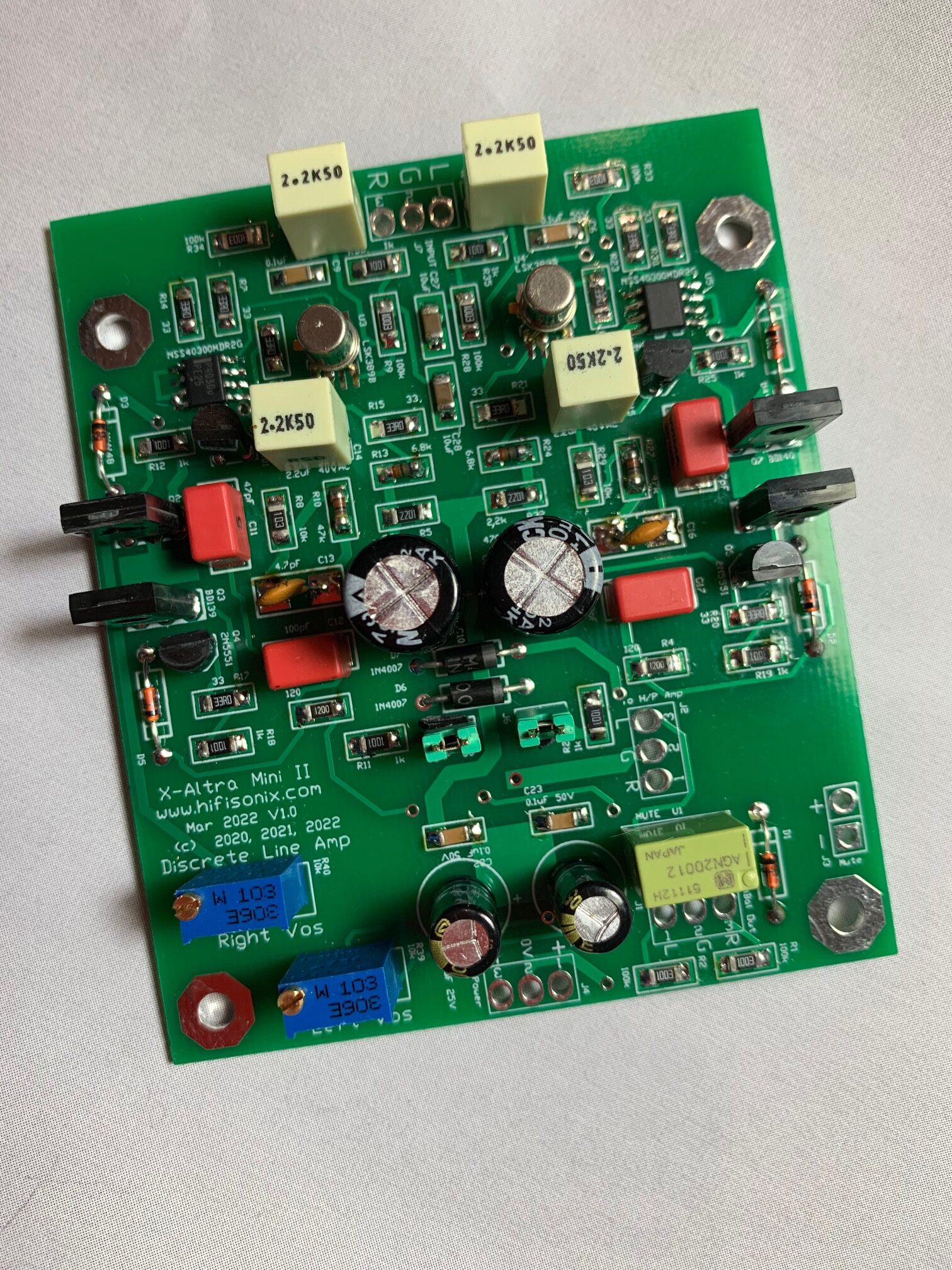
This discrete JFET input line stage can drive a 2k ohm load to 6V RMS in class A at less than 30 ppm distortion and at 3V RMS into 2k ohms, the distortion is around 7ppm at 1 kHz. The output stage runs at 20mA standing current. A jumper allows the user to select either standard Miller Compensation, or Transitional Miller Compensation (TMC). Output mute relays can be controlled by a user provided circuit, or, they can be driven off the /MUTE output available on the Hifisonix Standard PSU.
Attention: Errata: The PCB silkscreen shows D2 and D5 as BAT85. Please use 1N4148 in these positions and do NOT use BAT85
Here are some performance measurements using the Texas Instruments JFE2140 dual JFET in place of the LSK389 originally specified. The TI device offers better device matching and slightly lower overall noise – its also readily available from Mouser
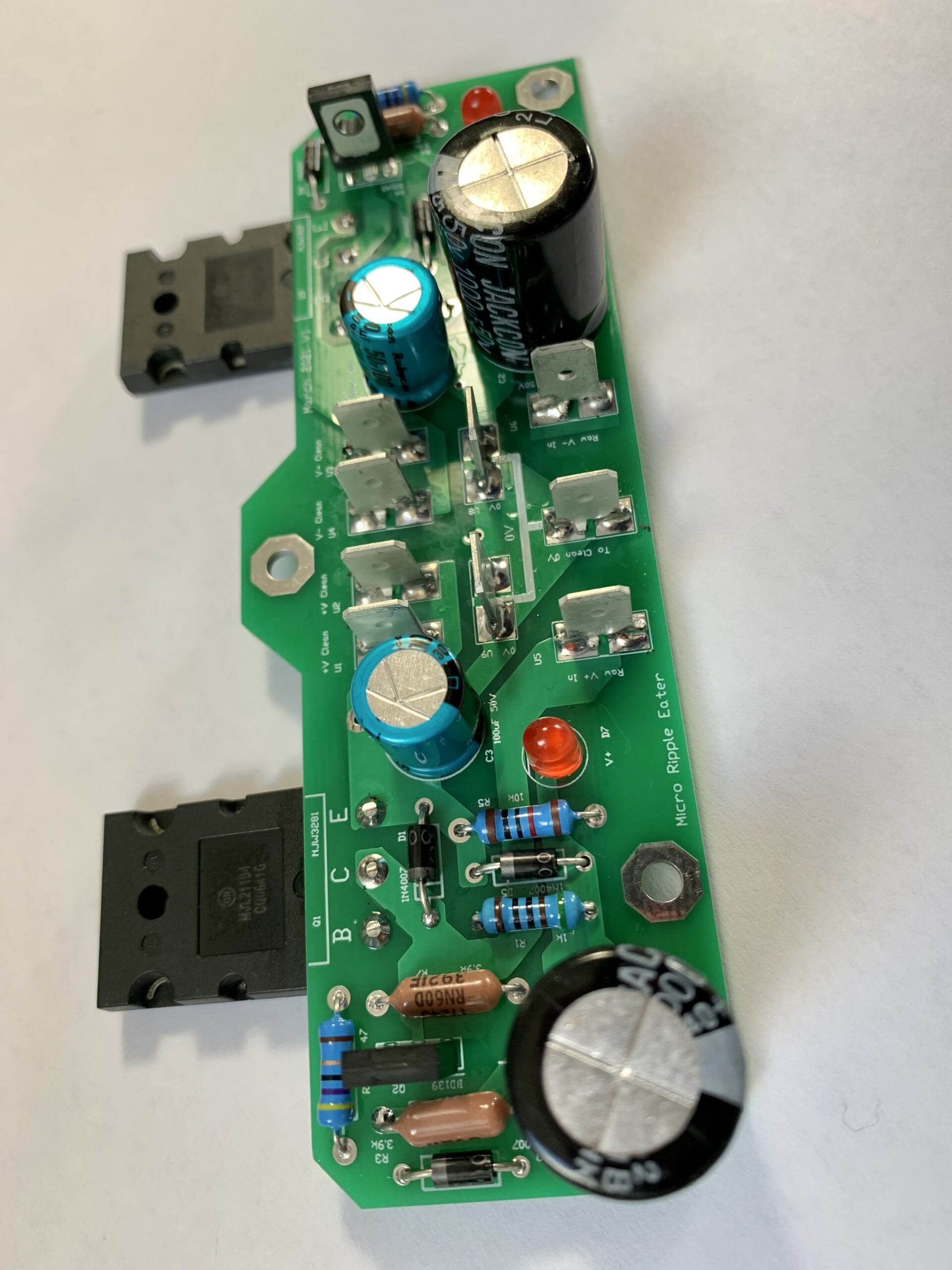
This simple ripple eater (aka MRE) can deliver up to 10A per supply rail (provided it is suitably heatsinked!) and will reduce mains related ripple on amplifier supply rails by up to 40 dB and as much as 50 dB at HF.
The board is small, compact and easy to mount virtually anywhere within the amplifier chassis. You can use a single ripple eater to comfortably power stereo amplifiers of up to 100W per channel, or you can use one per channel to clean up the supply rails on higher power amplifiers. The series pass transistors are not critical and any 15A TO3-P or TO247 type packaged devices will work.
The Hifisonix MRE makes a perfect upgrade to class A amplifiers where the usually heavy load current can cause excessive supply rail ripple. At 2.5A load current, the MRE 100/120 Hz supply rail ripple is under 20mV vs 1~2V pk to pk using a standard rectifier + reservoir capacitor setup. At higher frequencies in the audio band, it is even better and with good amplifier construction and cable dressing, can be well below 10mV pk~pk. Further, the slow start-up of the MRE helps to reduce switch-on thumps from the speakers.
Download the PDF build doc below (updated 4th December 2022)
Can the MRE be used with amplifiers that have supply rails > 50V?
The MRE is designed to work with amplifiers with supply rails of up to +-50V. If you want to use it with higher supply rails, the voltage rating of the capacitors has to be increased. The maximum diameter on C1 and C2 is 16mm and on C3 and C4 10mm. The transistors specified in the BOM are good for up to +-80V supply rails.
(Note: The pictures show the slightly older version of the MRE. The newer version is a bit smaller. The Hifisonix Universal Chassis drill pattern accepts the newer version of the MRE – the older layout version is no longer available)
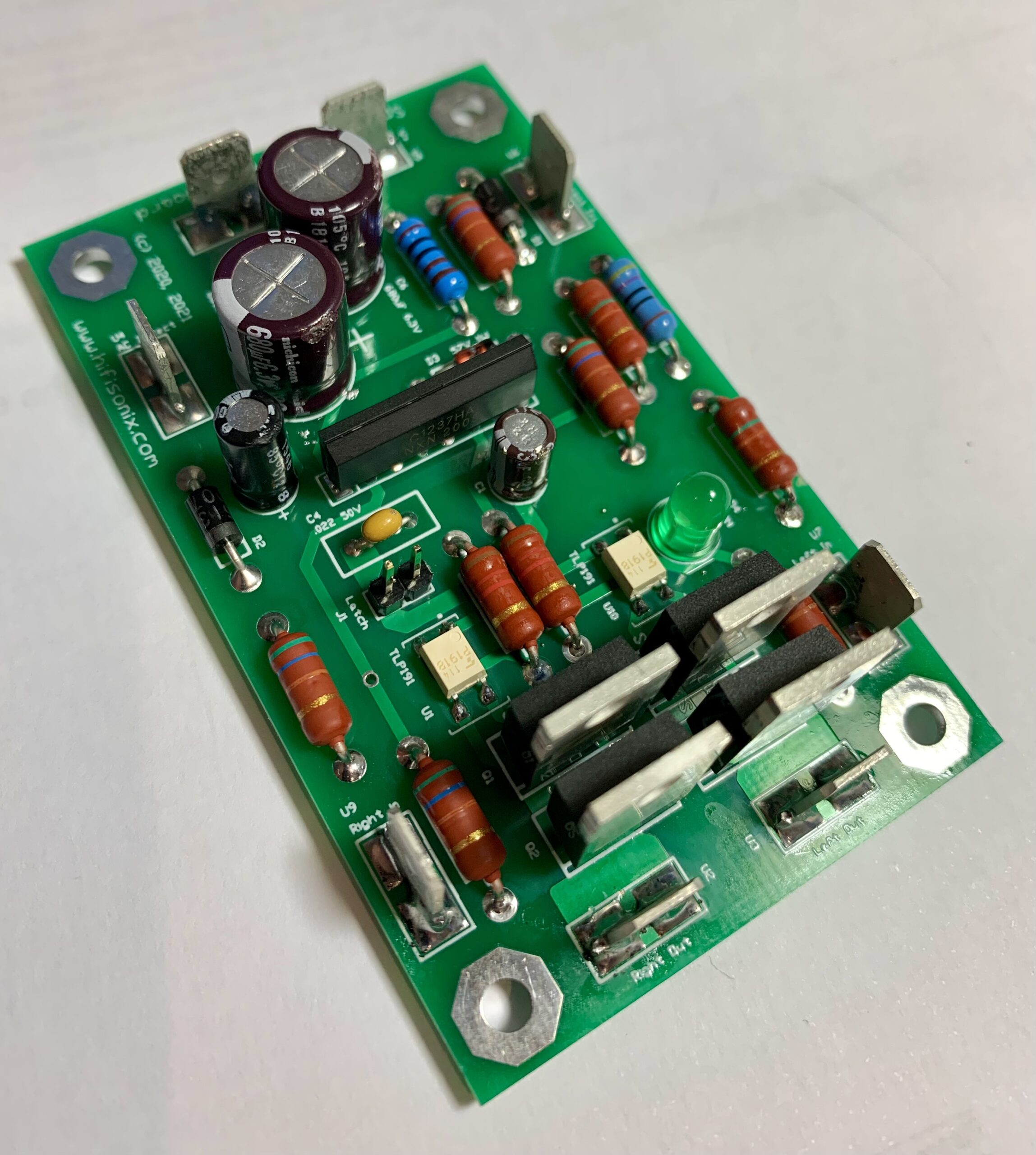
This simple, low-cost speaker protection board measuring just 82mm x 50mm uses the ubiquitous UPC1237 from Unisonic, a Taiwan based semiconductor manufacturer. The circuit will work from 25V through to 75V and uses mosfets to switch the speaker load rather than relays which are problematic and unreliable. A current overload input is also provided, allowing builders to arrange to sense an amplifier output short circuit and rapidly disconnect the amplifier output. The presentation below describes the operation and how to select resistor values for different supply voltages (updated April 2023).
ATTENTION: On some amplifiers, the turn on delay is not long enough to allow the amplifier to fully settle, and/or, the tolerance of C1 (33uF electrolytic) is not tight enough i.e. on +-20% types, the value can as low as 26uF. This may result in an audible sound because the output mosfet relays are energising too quickly. The recommended fix for this is to change C1 to 47uF or 56uF. The circuit will still operate successfully with values up to 100uF. Use 16V or higher voltage rating. Do NOT attempt to change the values of R3 or R5 to increase the delay as this leads to other problems, one of them being that the mosfets do not fully turn on which will almost certainly cause them to fail.
ATTENTION: If you are using the speaker protection board with the new nx2 amplifier, R7 must be changed to 33k. The reason for this is these amplifiers use a random phase opto-triac that switches the current protect output on the amplifiers to the +ve rail. The UPC1237 maximum current into the current trip input cannot exceed 3mA, otherwise the chip will be damaged.
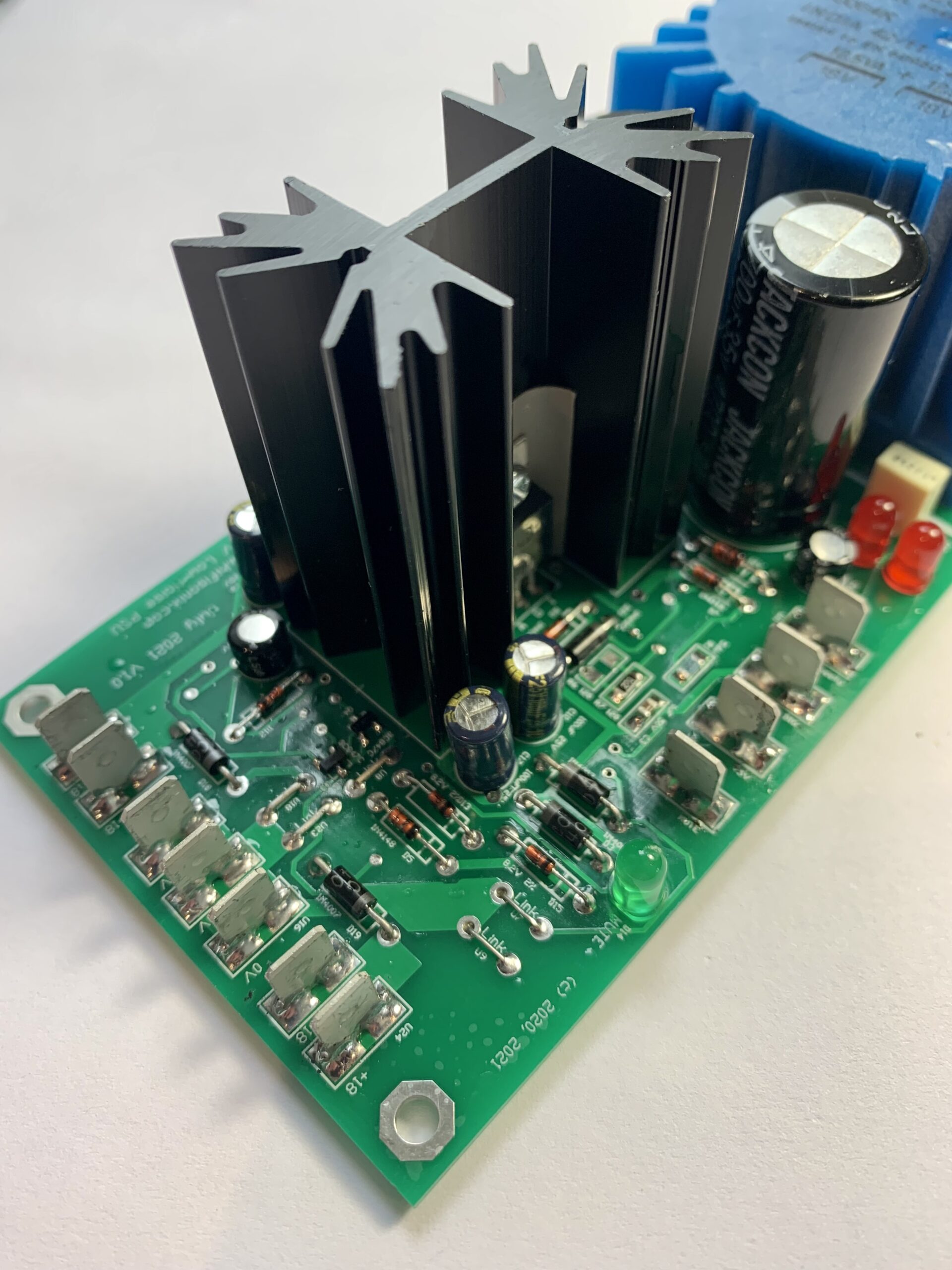
The Hifisonix Standard PSU features low noise, up to 400mA per rail output current, a MUTE relay driver to ensure when the load powers up or down there are no clicks or thumps, a +12V 40mA relay PSU and an auxiliary +5 or +3.3V supply (60mA max current draw) for powering any auxiliary logic or microcontroller circuits.
Output voltages are trimmed to exactly +-18 volts by means of two trimmer potentiometers. The power supply features very low full load (15 or 25W depending upon the power transformer chosen) noise with mains peaks at or below 100uV and thermal noise below -130 dBV.
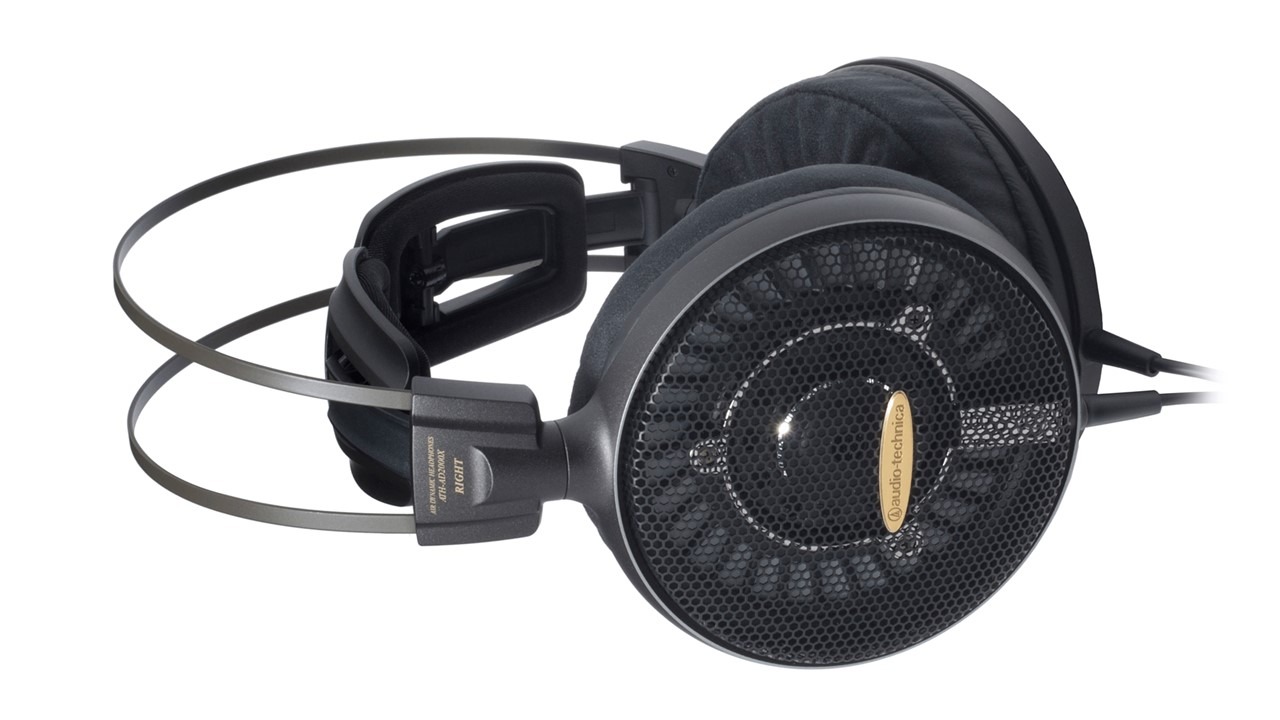
The circuit combines a dual ultra-low distortion opamp, the LM4562 or OPA1642, with a class A discrete power output stage to deliver outstanding performance both measured, and sonically. The complete amplifier, including the opamps, runs in class A. Into 60 Ohm headphones and above, the HPA-1 remains fully in class A up to the rated 21 V pk-pk output swing (note, it will actually swing a few volts higher on higher load impedance headphones).
The picture below shows how to wire the Hifisonix Standard PSU, which has a built in Mute function, to the HPA-1. This will prevent any power ON/OFF noises
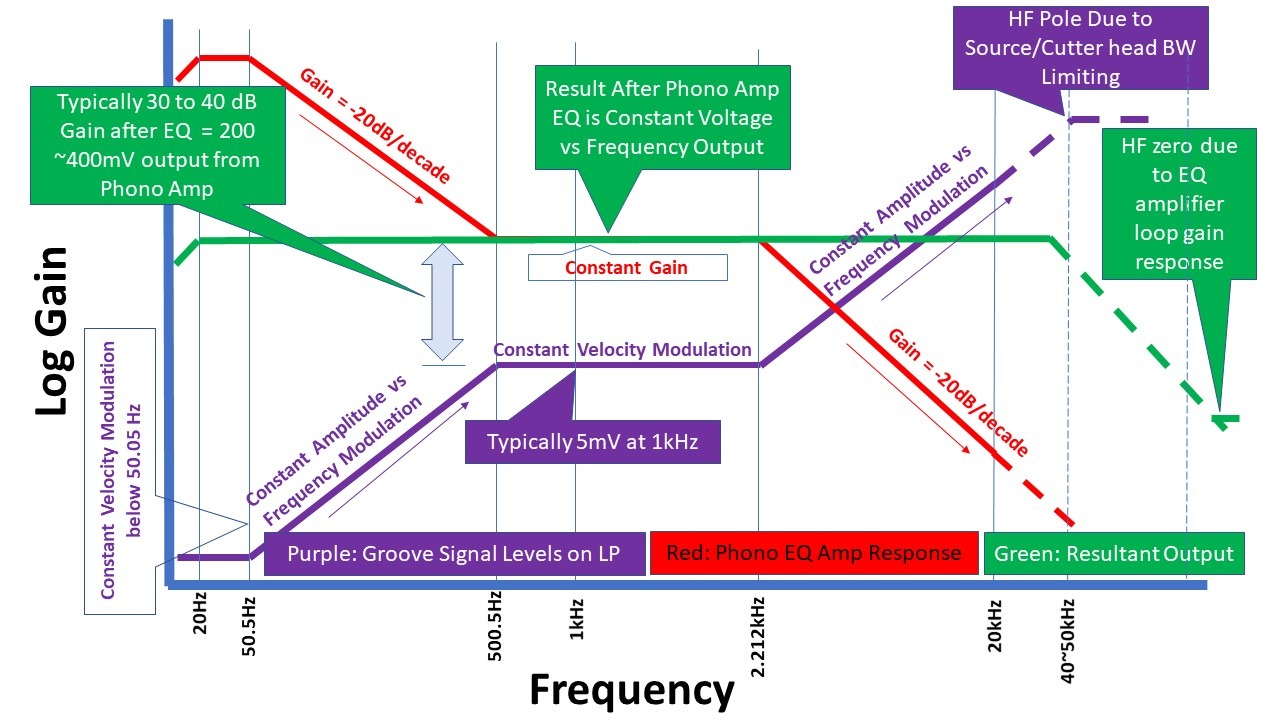
The diagram above summarizes the interaction of the cutting head response (purple) and the playback EQ (red) which produces the final flat response (green). Note that the cutting head and the phono pickup (cartridge) are velocity transducers and therefore the cartridge output rises at 20 dB/decade if the record groove is cut at constant amplitude.
Designing and engineering RIAA equalizers demands a clear understanding of the signal chain requirements during the development process. Once components have been committed to a prototype PCB however, testing is required. Presented here is a simple Inverse RIAA Network, or IRN, that allows testing to be quickly and effectively done.
It is important that the RIAA equalizer response is accurate across the audio band (20 Hz to 20 kHz) and also well behaved beyond that. The usefulness of this simple tool can be gauged by the fact that, after building an RIAA EQ amp based on a design published by one of the foremost exponents of the art, testing revealed that whilst its sine wave response conformity from 20 Hz to 20 kHz was exemplary, the gain at 500 kHz was 8 dB higher that at 20 kHz, which manifest as overshoot on the square wave tests. Some simple mods to the RIAA network resolved the problem, and the response was then flat out to ~50 kHz, after which it dropped off ultimately approaching at 20 dB/decade at 200 kHz
Pictured below is the conformity of a high performance phono amp using the IRN. The reading was taken with a QuantAssylum 401 measurement DAC/ADC set to 20 to 100 kHz display bandwidth sampling at 24bit/192 kHz.
Above: 20 Hz to 100 kHz frequency sweep response of RIAA amplifier fed through the IRN
Note in the picture above, the drop off in response below 100 Hz is due to the analyser response, and not the RIAA equalizer which is flat down to 20 Hz (rumble filter switched OUT).
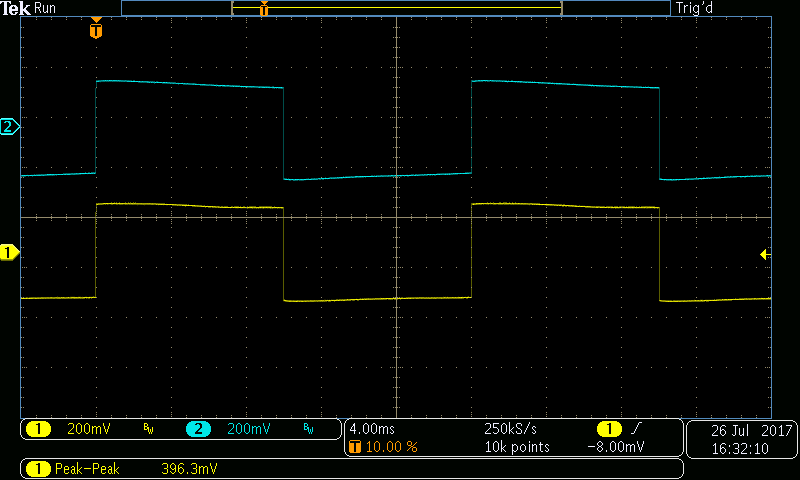
The scope screen shots that follow (which are for the same RIAA amplifier) show how easy it is to test an RIAA EQ amp using just an IRN and a square wave stimulus. In the first picture, we see the performance at 20 Hz. The waveform tops/bottoms show a small amount of slope which is caused by a slight roll-off at 20 Hz (around 0.3 dB in this particular design).
Above: RIAA EQ response to a 20 Hz square wave input stimulus fed via the IRN.
The shot below is for a 2 kHz square wave input stimulus. Since the square wave stimulus contains harmonics that are accurately amplitude related to the 2 kHz fundamental, this result implies that the response is accurate to at least 10 kHz (5th harmonic). The amplitude of the harmonics beyond 10 kHz is low, and therefore it is difficult to infer a high degree of accuracy above this frequency. Testing therefore has to take place at higher stimulus frequencies to confirm this.
Above: RIAA EQ output with a 2 kHz input stimulus fed via the IRN.
The shot below is for a 20 kHz square wave stimulus. The response is still remarkably good and in accordance with the results shown in the frequency sweep shown earlier. Since there is slight rounding of the edges, we can infer that the response has started to drop off above about 50 kHz.
Above: The response of a high conformity RIAA stage to a 20 kHz square wave input stimulus via the IRN.
Finally, the plot below shows the performance with a 50 kHz stimulus. The edges are rounded showing that the response is dropping off in a controlled manner (i.e. no overshoot or HF response anomalies) in accordance with the design requirements.
Above: RIAA EQ amp with 50 kHz square wave input stimulus fed via the IRN.