Blog

  • Very Simple, Accurate RIAA Phono EQ Amp

    Very Simple, Accurate RIAA Phono EQ Amp


    Very High Quality Silk Screened PCB’s for this project are available from Jim’s Audio here:-

    Hifisonix RIAA Amplifier

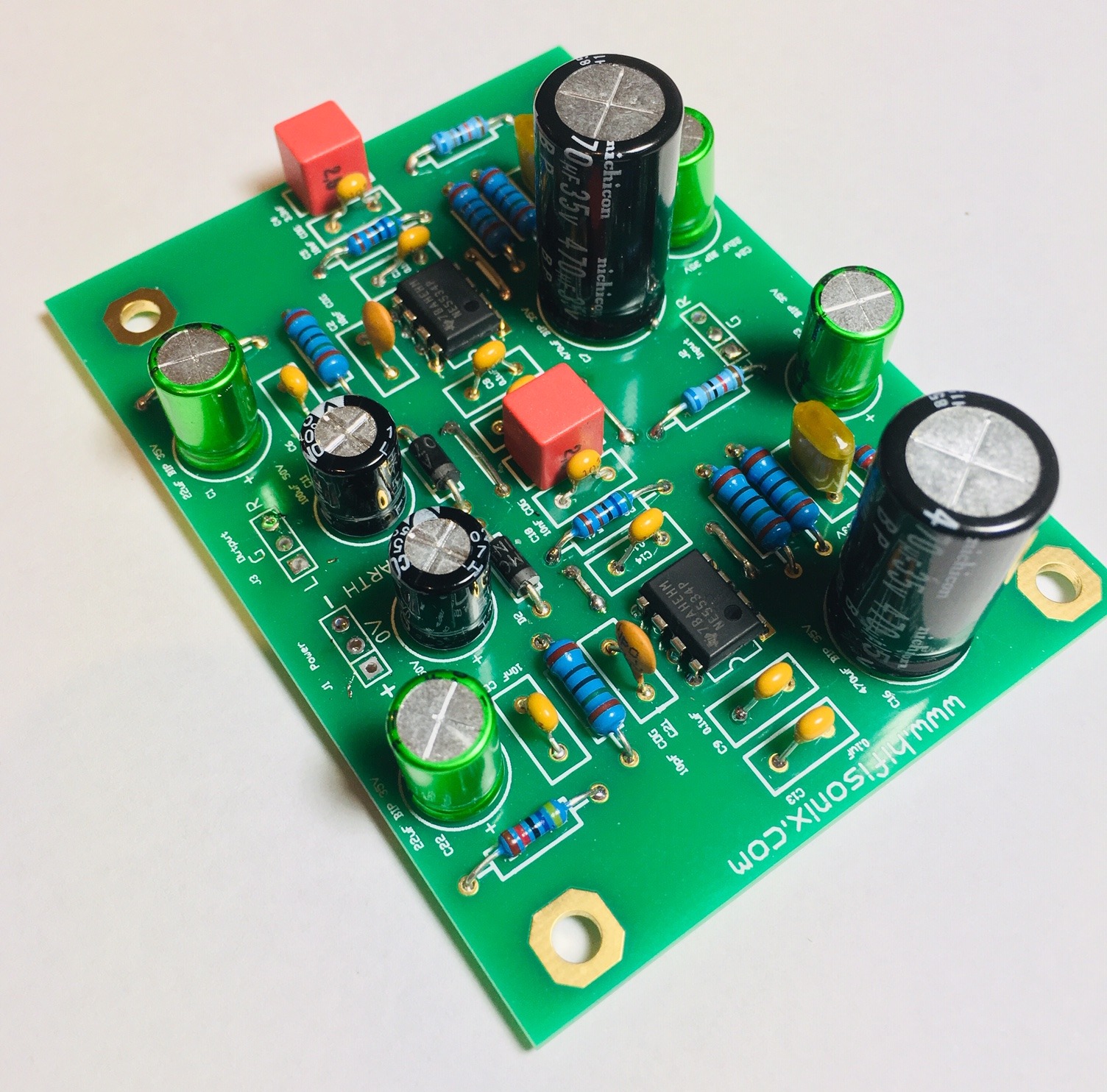
    Here is a simple no-nonsense, accurate RIAA equalizer amp you can easily build.  The design uses an all-active topology and is based around an NE5534A low noise opamp. I make no claims for originality but you wont find any voodoo engineering, fairy tales or outrageous claims: It simply does what it says it does in the specification.

    A complete stereo board can be built for about £25 ($35), but probably less.


    The article provides some background information on the RIAA EQ standard, launched in 1954, and why it came to be the de facto industry standard after about 1960.

    hifisonix RIAA Phono EQ

    To use the PDF PCB layouts below, you must print the documents out on A4. Measure the reference line lengths to make sure they match. You printer should be 600 DPI resolution or better.  However, I strongly recommend you just buy the PCB’s from Jim’s Audio – link above.  These are very high quality boards, silk screened and gold flashed.

    Overlay and 1:1 PDF negative and positive for the EQ board:  Hifisonix Phono EQ Amp for Doc114

    Optional PSU Overlay and 1:1  PDF positive and negative: Hifisonix Phono EQ PSU106

    Gerbers for both the EQ amp and the PSU   Hifisonix RIAA EQ Gerbers      Hifisonix RIAA PSU Gerbers

    Any questions, feel free to email me.

    Can I use other op-amps with the Hifisonix RIAA?

    Yes, you can. I recommend that you use unity gain stable devices with will not require an external compensation capacitor, unlike the NE5534 used here. You must  first REMOVE C2 and C21 – these are the 10pF compensation capacitors.  The number of good opamps in 8 pin plastic DIP packages (PDIP or mini-DIP) is unfortunately not what it used to be, so you may have to use a SMD to PDIP adaptor if you want to go down this route.


    The plots below are for HIGH gain.

    The plot below is of the RIAA noise and distortion at 500mV output at 1 kHz A weighted. This was with board on the workbench, no screening or special precautions and the power supply located about 15cm away.  In a metal housing, you can expect about a 30 dB reduction in the 50/60Hz noise.  There is quite a bit of noise being picked up from the surrounding CFL lamps etc, but the distortion is almost entirely 3rd harmonic (at -70 dB), with a bit of 5th at about -85 dB.


    The plot below is the frequency response after the source signal is passed through a very accurate inverse-RIAA network. The white noise frequency response measurement technique used eliminates  extraneous noise sources and is therefore extremely useful.  It works by looking at the power spectral density of the amplifier output, which for a white noise source, is constant per octave. If the amplifier response (after passing through the inverse RIAA) is indeed flat, then the overall response will be flat. The A-D was set to 24bits /192 samples per second and the response display set to 30Hz to 100kHz. The RIAA conformity is excellent with no HF peaking and starts dropping off cleanly beyond about 30 kHz.


  • Amplifier History: The JBL SA-600

    Amplifier History: The JBL SA-600


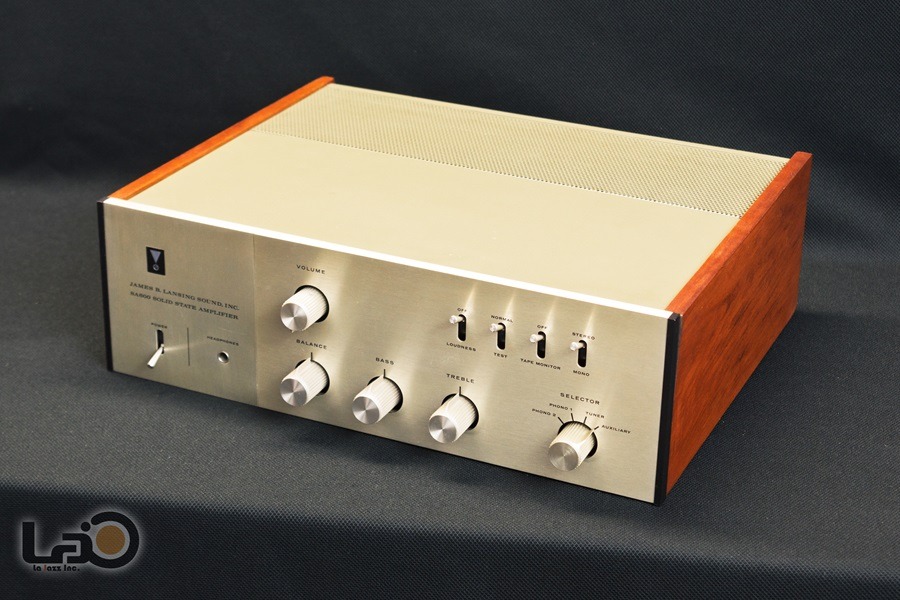
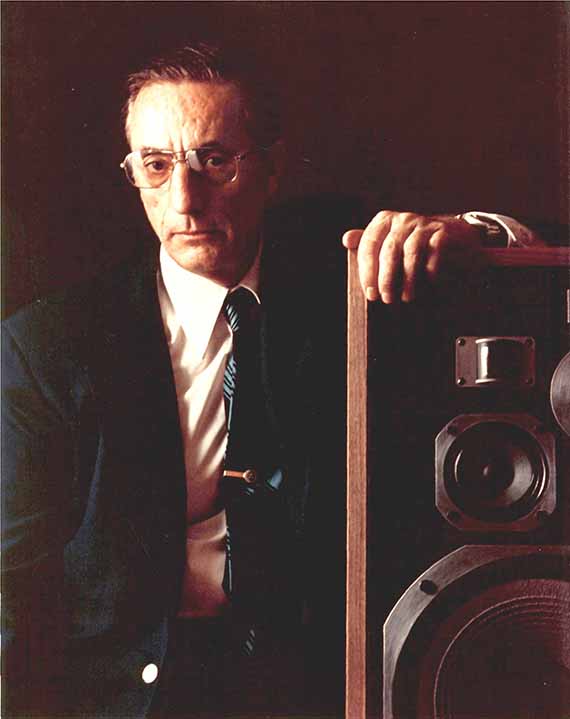
    The beautifully styled JBL SA-600 amplifier was launched by the James B. Lansing company in 1966, and Bart Locanthi (the designer) wrote the  technical article (link further down) in January 1967.  This is one of the earliest – if not the earliest – example of a commercial  amplifier that addressed the potential for TIM/SID and that of Large Signal Non-linearity (LSN).

    In the mid 1960’s, most engineers were still working with tubes which had low loop gains and were not equipped to deal with the wider bandwidths, higher loop gains and attendant phase shifts that multi-stage solid state amplifiers offered. However, the SA-600 designer, Bart Locanthi, had cut his teeth on military guidance systems in the 1950’s – the heyday of the analog computer – and would have been, as I have remarked elsewhere on this site, highly cognisant of things like slew rate, slewing distortion, loop gain, phase margin, overshoot and so forth.  Unusually for the time, the front end diff pair (Q7 & Q8)  is degenerated and loop compensation provided by an 82 Ohm and 150 pF resistor across their collectors along with a 220 Ohm and 75pF network from the VAS output to ground.  It operates in inverting mode, which has been tried on numerous commercial amplifiers over the years (the modern take on this is that non-inverting mode offers advantages with respect to noise performance).  This design delivered 30 Watts RMS per channel, which was more than enough for the efficient loudspeakers of the day, and quite in line with the general power levels on offer from tube based gear.

    Locanthi’s EF3 output stage, nicknamed the ‘T’, has remained the go to circuit for high performance solid state amplifiers  – it features wide bandwidths, very high current gain, and can easily be scaled up by adding output transistors in parallel.  Because of the high gains involved, care is needed in layout along with good local decoupling.  Although we do not have the rest of the power supply details, it seems this was well taken care of along with the base stoppers preceding Q3 and Q4.

    Bart Locanthi

    Nowadays, we would do things a little differently insofar as compensation goes (for example, the VAS would not be loaded to ground), and the VAS would certainly be loaded with a current source in the manner described by Douglas Self’s ‘blameless’ amplifier.  Nevertheless, this design is a classic and was years ahead of its time in a number of very important aspects. Otala’s paper on TIM was still a few years away and he would regrettably draw the wrong conclusions from his findings i.e. that TIM is the result of feedback. We now know this is emphatically not the case – its all about how it is applied.

    It should be remembered that solid state devices were still in their infancy, and very expensive compared to todays prices – this required some creative engineering to minimize costs and still end up with reasonable performance which this design certainly does.

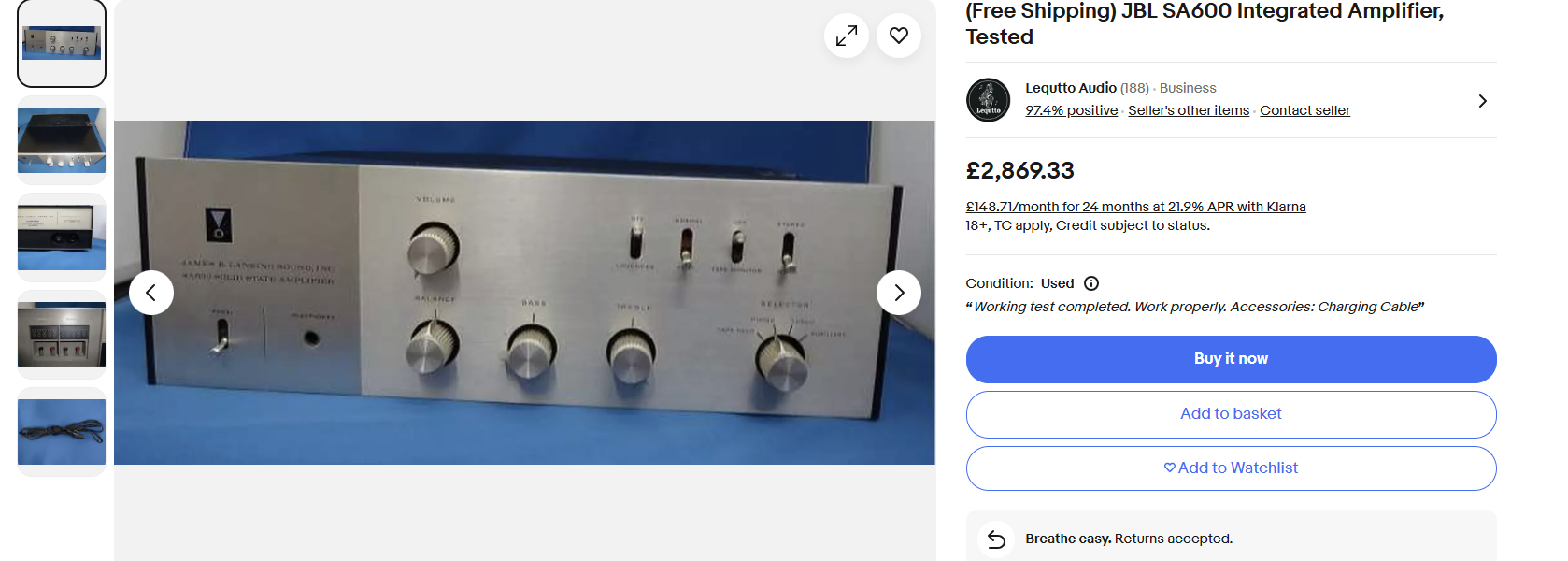
    However, the other fascinating thing about this amplifier is that it has held up its value remarkably – a bit like a Rolex watch.  If you root around on eBay or any of the pre-owned hi-fi websites, you are unlikely to pick up a cosmetically good working unit for less than about $2000 (!) and I’ve seen immaculate exemplars for sale at over $4000 (eBay Japan). So, highly regarded in its day for its liquid tube like sound,  and still sought after as a collector’s piece – which just goes to show that a well-engineered product – be it solid state or tube – can hold its value for decades and still deliver an outstanding listening experience when partnered with sympathetic ancillary gear.

    You can read Locanthi’s original description of his design below :-

    Locanthi Amplifier 1966

    Here is a short review of the amplifier done in 1966 by Julian Hirsch

    JBL – SA-600 Stereo Amplifier (J.D.Hirsch) (1966)

    A vintage JBL SA600, recently restored for a member of Audio Science Review, underwent technical assessment by the ‘Chief Fun Officer’, Amirm. While the restoration was extensive, my analysis suggests the amplifier still exhibits residual faults. Specifically, the measured level of hum and noise, even by 1966/67 standards, would have been considered unacceptable for a product of this calibre. Modern, well-engineered amplifiers will surpass the JBL SA600 in terms of absolute hum, noise floor, and distortion levels and this simply reflects the maturation of audio design, where knowledge has disseminated widely since the SA600’s era.

    Despite these observations, reviewer Amirm acknowledged the amplifier’s performance considering its 60-year vintage. Notably, Julian Hirsch’s original review cited measured hum and noise figures exceeding -100 dB, a remarkable achievement. In my view, this discrepancy suggests the restored unit tested by ASR may still harbour unresolved issues. At the time, the SA600 competed primarily with tube amplifiers, which exhibited higher noise, hum, and distortion while delivering significantly less power than the SA600’s conservatively rated 30 to 40 watts, as noted by Hirsch.

    Interestingly, the placement of input and power connectors on the amplifier’s bottom chassis reflects the prevailing audio system design of the time. In an era where systems were often integrated into wooden consoles, this configuration facilitated efficient cable management.


  • Solid State Feedback Amplifiers: A Short History

    “Why, sometimes I’ve believed as many as six impossible things before breakfast.”
    Lewis Carroll, Alice in Wonderland   

     A Future Without Feedback by Martin Colloms

    There is no mysticism in amplifier design, just serious science.
    Andrey A. Danilov

    Introduction

    You will recall from the The Theory of TIM by Matti Otala elsewhere on this site, that one of the consequences of the discovery of TIM in early solid state amplifiers was the erroneous conclusion that it was caused by feedback. By the time high loop gain solid state amplifiers really made their presence felt in the mid 1970’s (remember those Japanese receivers with the cool looking dials and green and blue lights?), vacuum tube amplifiers had ruled the roost for close to 50 years.  The  problem more often than not with tube amplifiers was lack of loop gain, or due to transformer coupling and attendant phase shifts, the inability to apply large amounts to linearize the system – 1% distortion was the norm, but really good designs might get you to the 0.3~0.5% mark at 1 kHz. Reading through solid state technical literature of the time, one comes away with the sense that most designers were groping around in the dark, trying to make sense of the new solid state paradigm, wide bandwidths, high feedback and  how to manage this combination effectively. It is clear with hindsight that although the solutions were ultimately simple, the real cause of the dilemma was that there were a number of interlinking factors, which we will touch on a little later, that took some time to tease apart.

    Dealing with the 20 dB loop gains and limited bandwidths that were the norm in tube equipment left the vast majority of designers ill-equipped technically to make the transition to solid state Voltage Feedback Amplifiers  (VFA) where the figures were 40 ~ 50 dB and open loop unity gain loop frequencies of 500 kHz or more. There were a few notable exceptions of course, one of them being Bart Locanthi of JBL who, judging from this design dating from the mid 1960’s was already cognisant of the challenges of high(er) feedback. He employed degeneration of the LTP stage of what was then an early high power solid state amplifier in order to improve the dynamic performance and linearity.  Earlier in his career he had worked in analog computing where much of the research in the 1950’s was around military equipment and  servo systems. He would therefore have been aware of things like loop gain, slewing, transient recovery, phase and gain margin – all critical parameters in servo systems, and as the industry came to learn years later, solid state audio amplifiers, but a rather alien world to vacuum tube consumer electronics designers in the 1960’s.

    Prior to Otala’s work, most amplifier designers naively saw feedback as some sort of panacea, to be applied in huge quantities to reduce distortion, invariably quoted at 1 kHz, which masked a host of evils that would be plainly evident at 30 kHz. One could arguably conclude that Otala discovered in TIM what was already known in another engineering discipline (servo and control theory), but  failed to interpret and apply his findings correctly – a point Bruno Putzeys’ touches on in ‘The F Word’.  We owe Otala a debt of gratitude for spurring the industry wide investigation into feedback his paper triggered, but the road to understanding the intricacies of feedback as applied to solid state audio amplifiers, and to being able to build high performance products, was to take at least another twenty years.

    The Four Evils

    In the first of what I shall term the four evils, many amplifiers from the time ran the front end LTP transistors at very low tail currents in the 1 mA region and I’ve seen power amplifier designs with 500 uA tail currents – so 250 uA in each LTP half. This immediately limited the peak current that could be supplied to the TIS integrator (trans-impedance stage aka VAS), and severely hobbled the LTP’s ability to handle input transients because it lacked the current needed to charge and discharge the compensation capacitor rapidly at HF.  The second evil was the failure to degenerate the LTP transistors – the gm as a result was high, contributing to the high overall loop gain.  Worse however, the high gm results in a narrow linear operating region such that each half of the pair can be ‘flipped’ ON or OFF with very small differential input signals – and that, as we shall see, is a serious shortcoming. The third evil was the lack of high fT, large SOA output devices – the 2N3055/2N2955 and later MJ15003/MJ15004 devices  featured pedestrian 1~2 MHz fT’s – in other words, they were incredibly bandwidth limited and would only work in a system if the unity loop gain frequency (ULGF) was low. All the more reason why Bart Locanthi’s amplifier was such a breakthrough as he built a credible amplifier with what by today’s standards would be seriously compromised output devices.  If one has to try to design an amplifier with these devices today, the unity loop gain frequency would have to be set to 300 kHz – about 5 times lower than in modern amplifiers where  devices like the  NJW3281/1302  are employed that have fT’s of 30 MHz, very high Ic vs hFE linearity and superb SOA capability. This in turn would have then limited the amount of feedback available to correct distortion and is one of the reasons amplifiers from the period generally have distortion figures of 0.007 to 0.01% – about 10x to 15x modern amplifier figures. There were a number of cases where commercial amplifiers would self-destruct if the wrong type of speaker cable was used (it needed to have high inductance to isolate any capacitive load). These products were marginally stable with insufficient gain/phase margin to deal with real world loads.  The fourth evil was that in order to tame the tendency to break into oscillation given the high loop gains and slow output stages, heavy MC (Miller Compensation) around the TIS (VAS) was applied, where I have seen capacitor values as high as 1 nF.  In an attempt to tame the amplifiers predilection to break into oscillation, all sorts of frequency shaping networks were applied across LTP load resistors, or heavy handed shunt compensation was used from the TIS output to ground in these old designs. With modern circuit simulation CAD tools like LTspice, amplifier compensation design and optimization is a cinch – designers in the 1970’s were in effect ‘flying blind’ in this area.

    When you present an amplifier with a fast transient on its input,  the LTP pair has to charge the compensation capacitor around the 2nd stage TIS integrator. In an amplifier that suffers from the evils mentioned earlier (and especially evils one, two and four – low tail current, high gm and oversized compensation capacitor), the LTP transistor halves will switch fully ON or fully OFF depending on the signal slope (+ve or -ve). When the amplifier does this, it runs open loop – i.e. without feedback and the output then slews towards one of the supply rails. The result in severe cases is the output rams up against one of the supply rails until the LTP regains control again a few micro seconds later and the loop runs normally again until the next fast music transient. This is what TIM is and it sounded terrible to audiophiles who were used to the smooth, euphonic sound of tubes. In designs that did not go ‘fully TIM’, the amplifier would slew for a shorter period, but not ram up against either of the supply rails. The sound was equally objectionable and this is called SID or Slewing Induced Distortion. There are plenty of commercial amps and DIY designs from the period, that with a full power sine wave stimulus, went into slewing at 30 or 35 kHz  – already absolutely unthinkable by the standards of 1998 when Colloms piece was published.

    Superbly Low 1kHz Distortion But Flawed Sonics

    With a steady state 1 kHz sine wave input stimulus and near full output power (a typical 1970’s test regime),  a highly compromised amplifier suffering from the 4 evils would test out superbly. How can this be? Amplifier distortion performance  used to be assessed at full power using a 1kHz stimulus.  The output rate of change of a 1 kHz sine wave at the zero crossing on a 100 W amplifier is only about 250 mV per microsecond – a snails pace even for our compromised amplifier, which would pass this test with flying colours, and because of the very high loop gain, distortion would low. Now feed a fast rise time  – say 10 us – 1 kHz square wave stimulus for full output power (about 8 V/us slew rate) and our amplifier performance falls to pieces. Full power square wave testing, or indeed full power HF sine wave testing, was almost never carried out on these products because of cross conduction problems in the output stage – so square wave testing was always small signal – i.e. 1~2 V peak output and the problems alluded to above thus never showed up. Further, testing was usually conducted with a resistive load, so marginally stable designs often slipped through the net and went on to fail in the field because they broke into oscillation with real world capacitive loads.

    Otala’s Misguided Legacy: Feedback is Bad

    Following Otala’s paper, a number of old wives tales about feedback emerged that still persist despite 40 years of engineering evidence and scholarly research to the contrary – and regrettably repeated in the Colloms article. One enduring fallacy for example, is that the open loop, low corner frequency (a few Hz to maybe a few hundred Hz) that one finds in Miller compensated (MC) amplifiers mean these are ‘slow’ and cannot follow fast music transients and this leads to TIM and the solid state sound.  This is entirely incorrect at every level – the MC open loop corner frequency has nothing to do with slew rate of an amplifier – almost all VFA opamps (other than uncompensated or de-compensated types) use dominant pole (i.e. MC) compensation with corner frequencies of just 1 or 2 Hz that are blindingly fast and even at closed loop gains of 10x or 20x will have -3 dB bandwidths of 3 to 5 MHz,  slew rates of 20 to 50 V/us and full power undistorted rail-to-rail bandwidths of 200kHz. And it is no different with power amplifiers. Slew rate and the open loop bandwidth are set completely independently of each other.

    Another fallacy is that feedback is ‘slow’ and there must be a delay around the loop, or that feedback goes multiple times around the loop. Again, on both counts completely incorrect. The loop transit time or loop  ‘flight time’ of a audio power amplifier is about 15 nanoseconds i.e. 0.000000015 seconds to go from the non-inverting input through the amplifying stages to the output and back around via the feedback network to the inverting input. It is not at all dependent on how many stages are involved – 1,2 or 5 its all around the same time give or take a few nano-seconds.  There is therefore no delay in practical terms – only phase shift which is a completely different mechanism and a property of all circuits with reactive components  – with vacuum tube amplifiers exhibiting much greater phase shifts than solid state types. This has nothing to do with the TIM mechanism mentioned above. An amplifier feedback loop is near instantaneous and occurs at relativistic speeds and should not be confused with the slewing in TIM/SID which are entirely down to a combination of  insufficient current to control the TIS compensation capacitor and the high LTP gm.

    The feedback ‘doing multiple passes around the loop’ myth grew out of an analysis carried out by Peter J Baxandall  wherein he took a simple single stage amplifier and gradually increased the feedback, monitoring the distortion as he did so. At moderate feedback levels, distortion that was originally less than objectionable 2nd and 3rds folded into higher order harmonics, albeit at lower levels,  that were objectionable. There are a number expositions on this subject (Pass and Boyk and Sussman for example) on the web wherein this phenomena is used to bolster the zero or low feedback argument, but they  use highly compromised, non-linear circuits to try to make their point which is not representative of 21st century SOTA linear amplifier design. These very basic single ended circuits would be seen in hobbyist magazines from the 1950’s and early 1960’s. If you increase the loop gain i.e. feedback, beyond 20 dB, the distortion starts to decrease dramatically, so that at 40 dB loop gain and above, you are getting massive reductions in distortion and it is well below the threshold of human hearing at < 0.01%. The ‘sour’ spot for feedback is indeed the 6 dB to 20 dB region if and only if the amplifier distortion is high in the open loop condition. If it is, either don’t apply any, or make sure you apply plenty as Putzeys points out.  Importantly, the focus on open loop linearity in modern solid state amplifiers means that even with low feedback, they are still superbly linear. Today, we start off with an amplifier that at full power open loop shows much less than 1% THD (good designs are about 0.1%) and we then apply feedback around it – we don’t start with something producing 5%, 10% or 20% which is what Colloms suggests.  Notice also that many of these low feedback/zero feedback designs only quote distortion at low power levels, or at just 1 Watt output. Further, in Pass’ article referenced above, he talks about the problem of IMD in feedback amplifiers. Again, in amplifiers that start off with low open loop distortion, IMD is a non-issue – in modern designs -100 dB down on the test tones which are at full power. Zero and low feedback amplifiers cannot match this performance.

    Amplifier Feedback: Figuring it All Out

    It took until the mid-1980’s for engineers to figure out what was going on  – although people like Bob Cordell and Bob Sickler were years ahead of the general industry curve –  and another few years for this to percolate through the design community so that only by the early 1990’s do really capable solid state amplifiers that address all of the shortcomings outlined above, become the norm. Alas, those that bought into the idea that feedback was bad, ended up corrupting the whole science of amplifier design for  large parts of the audio amplifier design community, and the press,  and a sub-culture of subjectivism emerged wherein sub-standard products – in every sense of the word – are feted as ‘jaw dropingly good’ or ‘providing fundamentally new insights’ into music never before experienced.  Reality says it’s an amplifier and simply needs to have zero distortion, zero TIM and drive any speaker load down to 2 Ohms with better than 0.2 dB flatness from 20 Hz to 20 kHz. Insofar as slew rates are concerned, the minimum figure acceptable in modern amplifiers is 1 V/us per peak output volt. Thankfully in 2017 all of these requirements are fully realizable at reasonable cost (figure on $30-$35 per stereo watt 2017 retail price on a high end class AB amplifier). In the semiconductor industry, no feedback qualms exist, and hundreds of millions of opamps working in end customer feedback loops are sold and applied every year and work flawlessly – including the ones present in the output stages of every high performance Audio DAC on the market.

    Ensuring amplifiers (and specifically VFA types) don’t suffer excessive distortion nowadays is straightforward  because the associated mechanisms are fully and completely understood. And, in 2017 we really do understand the intricacies of negative feedback as applied to audio amplifiers, which it turns out in the big scheme of things, is an exceedingly simple application of control theory science. Firstly, make the amplifier linear in the open loop condition. This is easy to do and a well designed exemplar will be well below 1% at full power open loop i.e. zero feedback and nothing like the 20% Martin Colloms mentions which is the kind of open loop distortion one would expect to see in a sub-par tube amp. Secondly, ensure the LTP is degenerated so that under a worst case full scale input transient with fast rise times (1-2 us), it still operates in the linear portion of its transfer curve and does not approach cut-off.  In most cases this will necessitate some bandwidth limiting of the input signal but in high performance designs, this will be at 300+ kHz. Third, run the front end LTP stage ‘rich’ – i.e. at a high tail current.  Combined with the degeneration this will provide a large linear operating region of 1~1.5 Volts resulting in very low open loop distortion of the LTP; the high tail current means large transient currents can be supplied into and out of the TIS integrator stage. The result is no chance of TIM ever arising. Separately, the LTP must also be well balanced – a point Self stresses in Audio Power Amplifier Design.  Fourth, use modern, high fT, sustained beta output devices like the MJL1302/1381. Finally, close the global feedback loop such that there is a minimum of 45 degrees phase margin at the unity loop gain frequency – typically about 1.5 MHz in modern amplifiers employing EF3 output stages and higher than this in EF2’s. This is not an exhaustive list –  see Douglas Self and Bob Cordell’s books on amplifier design for a more in-depth treatment of the subject.

    The Zero TIM Amplifier

    Current Feedback Amplifiers  (CFA) first became available in IC form in the early 1980’s. Their prime application in the IC realm was (and still is) in very wideband, high speed  amplifiers – video drivers, telephony systems and test and measurement gear. Their operation is not as intuitive as VFA’s and they really have only come into more widespread use in audio power amplifiers the last 10 or 15 years. Had they been around in the 1960’s, it is arguable that most of the problems discussed in the preceding paragraphs would not have arisen – perhaps only compensation design and that is a relatively easy problem to get ones head around. Matti Otala would never written about the solid state amplifier sound or TIM, and the ‘solid state’ sound would have been a thing of wonder, and not a derogatory remark hurled at some highly compromised amplifier.  Why would this have been the case? CFA’s cannot  produce TIM since the front end quiescent current is not fixed as it is in VFA’s  – it is directly related to the output voltage and the value of the feedback resistor so it is expansive, and not compressive, providing current on demand to charge the compensation capacitor – typically up to 8x the standing value in a practical audio amplifier It is not possible to get a CFA’s to slew rate limit  – something even modern VFA’s will do when the LTP runs out of steam at 150~300 kHz (this is 5~10x the figure one would encounter in a mid 1970’s amplifier by the way).  With modern output devices, CFA  power amplifiers are quite capable of reproducing a very credible 100 kHz square wave at full output power into an 8 ohm load – see  the Ovation nx-Amplifier write up for example, page 14.  Lets also be clear here, modern VFA amplifiers that apply the cures for ‘The Four Evils’ discussed above will never go into slew rate limiting with music signals – the TIM problem  that plagued this topology in the 1970’s and early 1980’s is long gone – the issue is completely and wholly solved.

     Sighted Evaluation and Subjectivism

    Studies have shown that  human auditory memory is extremely fickle. We are designed to remember the information (who, what, where etc) encoded in sounds and speech, and much less so the exact details of the frequency, harmonic content, precise timing and so forth (note that this is not the same thing as remembering or being able to play a tune or sing in tune which is covered in the cognitive neuroscience of music). Double blind and ABX tests make this abundantly clear where most individuals struggle to tell the difference between amplifiers producing 0.5% distortion and those producing only a fraction of that. Further, we may be able to tell that there is a difference on switching from one to the other, but 5 or ten minutes later, assuming the differences are not gross – which they never are anyway – the chances of a correct identification are indeed slim, and research suggests short term auditory memory of the type being discussed here is about 10 seconds. We do also know that people find higher order harmonics objectionable and lower orders (2nds and 3rds particularly) euphonic. What science also tells us is that when it comes to hearing, like sight, as a species we are susceptible to inference – we believe what is suggested or inferred we heard because we have been told, or because A looks better than B. Therefore, claims that amplifier x is better than y based on sighted testing should always be questioned.  If you want to get to the truth of an amplifier comparison, there is no other way than the scientific way and that means DBT or ABX test methodology. Now, none of this means a thing if someone’s prime motivation for buying a piece of equipment is for looks, bling factor, bragging rights or some other subjective criteria – but then we are not talking about accurate sound reproduction, but about fashion.

    The Golden Age of Audio

    Today, in both professional and consumer markets, and in the DIY community, you can find solid state feedback amplifiers featuring distortion levels of <10 parts per million at 20 kHz, slew rates of 200 V/us or more along with the ability to drive enormously difficult, reactive loads. None of these amplifiers – VFA or CFA – have a hint of TIM, SID or any other kind of distortion – they are as close as it comes to a piece of wire with gain – Peter Walker’s famous aphorism.  Over the last decade or so, newer, more in-depth understanding of the way humans perceive distortion has emerged. We know, based on research that simple THD and IMD distortion metrics may not tell us the whole truth about what kind of non-linearity we can tolerate when we listen to  a piece of music. However, it is my contention (and Douglas Self no doubt would agree) that a modern, well engineered amplifier’s distortion profile (THD, IMD, GedLee, Rnonlin etc) is orders of magnitude below the hearing threshold. There is no distortion and the amplifier is effectively ‘blameless’.  I know from my experience with a high resolution system that it is very easy to pick out CD’s and LP’s in which clipping and other distortion artefacts can be discerned that have arisen in the recording chain that in all likelihood would not be audible on a legacy system – be it solid state or tube based. We are truly living in the golden age of amplification – and it has everything to do with a thorough and in-depth understanding of feedback and compensation design at an engineering level and all of the mechanisms of non-linearity in the amplifier.

    How do these modern, well engineered audio amplifiers sound? Open, effortless, smooth, detailed and supremely accurate – sound quality and performance that could only be dreamt of 40 years ago.
  • Technical Requirements of Phono Preamplifiers by Tomlinson Holman

    Technics Direct Drive Turntable (Photograph by David Gallard)

    The two articles below were written in the 1970’s, nearly a decade before the arrival of the CD and the ‘perfect sound forever’ claim made by Philips. There was a lot of focus on phono amplifier performance at the time which it could be argued was triggered by the arrival of very high performance turntables – the Linn Sondek and Japanese Direct Drive systems from Technics for example – but there were others like Micro Seki, Thorens and so forth as well. These turntables were for the most part, quiet with low motor noise and decent quality pickup arms.


    The arrival of Quadraphonic systems required much greater bandwidths and this had to be matched with improved cartridges that offered better tracking performance and a newer, greater understanding of the electro-mechanics of the pickup itself, and in particular the stylus, emerged as a result.

    Holmans first article investigated the dynamic requirements of phono amplifiers and represented the best effort at the time – and probably still so – to understand the absolute outer limits of phono amp overload requirements. The general consensus that was cemented from this work, and that of other investigators and cartridge manufacturers at the time (Shure being chief amongst them) was that a typical phono amp should deal with peak outputs of at least 25cm/sec (5cm/sec being the nominal output). This of course does not include factors like ‘hot cartidges’ providing 6-10mV re the nominal 5mV output levels and ‘hot recordings’ where the general levels on the disc, and associated peaks, were higher than average. On top of this, overhead for the inevitable crackles and pops was also required.

    The second article presents a practical MM design which should be read in the context of the available semiconductor devices at the time.

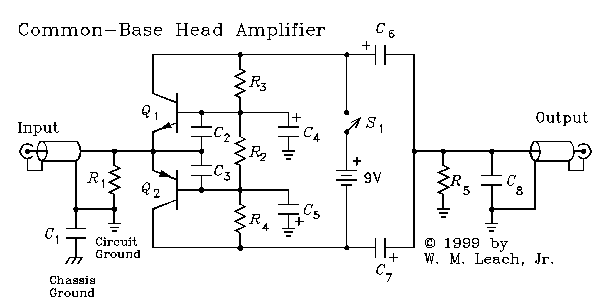
  • Richard Lee’s Ultra-Low Noise MC Head Amp

    Richard Lee’s Ultra-Low Noise MC Head Amp

    This design was a development of Marshall Leach’s MC head-amp, from the 1970s, and to my knowledge, Richard Lee’s implementation presented here has not been bested in terms of noise – about 280pV/rt Hz in a well-implemented exemplar – other than in the Hifisonix X-Altra MC/MM Phono Preamplifier. Importantly, it requires only about 12mA current in the +-15V rail powered version, and about a quarter of that in the battery version. If you try to achieve this type of performance with single-ended designs using PNP devices (the Diodes Inc ZTX951 being an excellent candidate), you will probably require 10 times the current of the battery-powered version or an opamp and a lot more circuit complexity.

    The original design back in 1980 was housed in a discarded ‘Duraglit’ tin (a type of polish in the UK used to burnish soft metals like brass, aluminum or pewter), and this design has thus become known amongst the DIY fraternity as ‘Richard Lee’s Duraglit Special’

    The design is not without its foibles in that it requires low rbb’ NPN-PNP complements, now (2019) difficult to get (other than the excellent Zetex ZTX851/951 types) and the gain is dependent upon the cartridge DC resistance – so you have to select the output load resistor appropriately. Nevertheless, it is a fantastic example of the ‘less is more’ dictum and achieves remarkable performance for pennies.

    Lee worked for various UK Hi-Fi outfits in the heyday of home audio in the 1960’s through 1980’s, including a stint at KEF and is now retired to Cooktown, Queensland, Australia where he relishes living as a ‘beach bum’ (his words, not mine!).

  • My Loudspeakers

    My Loudspeakers

    I bought a pair of B&W 703’s in about 2003 and they travelled with me all around Asia when I worked there as an expat for ten years. These are big loudspeakers with fantastic bass and mid-range articulation.

    The treble may be a little forward for some, but for Jazz, big band and rock they are absolutely superb – exciting, visceral and sonorous . I would describe the sound as effortless with a slightly forward treble balance and they can go very loud. They image well and the bass is crisp, clean and goes very deep. They are an easy load to drive with sensitivity specified at 89dB/W. If you hunt around on the web, you can still pick up an imaculate pair for about $1500 in the US or about £1000 here in the UK. Here’s a review from 2009

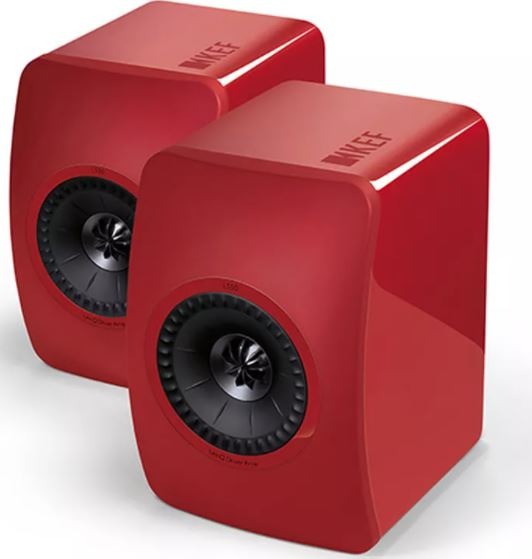
    The second pair of speakers I have are the highly regarded KEF LS50’s I purchased in 2017. These are near field monitors and in a small room are unmatched insofar as accuracy of reproduction and stereo imaging are concerned. My music space is quite large, so I cannot listen use them in near field mode, but the imaging and overall balance is still fantastic.

    They do not go deep in a big space, although if placed near a corner (500mm – not closer) or wall, the additional acoustic reinforcement does extend the bass down considerably. I use a B&W ASW60 sub-bass that augments them below 80 Hz to flatten the response down to about 35 Hz. I use these speakers to listen to classical music, acoustic and jazz. If you have ever been to a classical concert, when you listen to these speakers, you will appreciate how accurate they are, and how well they image (much better than the 703’s which are not too shabby in this area either). You can read the Stereophile review here and another review here.

    More recently, I bought a pair of Dali Oberon 5’s for the living room (the speakers above are in my music room), powered by one of my commercial products, the Model 1707 integrated amplifier. The Oberon 5’s have received rave reviews (here’s another one) since their introduction in late 2019. For the £749 asking price new, these are amazing loudspeakers. Not a hint of sibilance, fantastic imaging to boot and an open, warm sound. They’re compact and well built and will fit in with almost any decor. If you are looking for a pair of speakers to fill a medium sized listening space and don’t want to break the bank, I highly recommend you audition a pair.

  • The Endless Semantic Debate: Current and Voltage Feedback Amplifiers

    It seems some are still agonizing over the ‘current feedback’ versus ‘voltage feedback’ definition.  Clearly a case of people wanting to continue to flog a horse that was laid to rest five decades ago during the heyday of the analog computer, or they simply fail to grasp the CFA concept. I suspect there are an equal number of both types. This is the same crowd that deny the existence of CFA’s, claiming they are just ill-designed VFA’s. Here then is the question that vexes the CFA doubting Thomas’s:-

     What do we call an amplifier that actually has current feedback?

    Lets consider this whole current feedback thing by first making clear there are two very different issues to consider here: current output and current feedback and the voltage mode equivalents, voltage output and voltage feedback. Output mode and feedback mode are emphatically not the same thing, and anybody who makes this claim is simply playing word games to further their dogma. Quite depressing, given we are talking about an engineering discipline here – namely electronics.

    You can use either a voltage feedback (VFA) or a current feedback (i.e. CFA) amplifier to control its output as either a voltage or a current.

    A current output amplifier is an amplifier in which the output current is the controlled parameter.  Example: a 4-20 mA industrial loop where the load resistance or impedance can be changed, but the current remains constant and related to the input reference signal (be that in itself a current or a voltage).

    A current feedback amplifier is an amplifier in which the feedback from the controlled output parameter is in the form of a current.  

    Similarly, a voltage output amplifier is a device in which the output voltage is controlled. Example: a typical audio amplifier (be it a VFA or a CFA).

    In a voltage feedback amplifier, the feedback signal is in the form of a voltage (ignoring the typically minute bias currents) and the controlled parameter, the output voltage, is related to the input reference signal (again, be that a voltage or a current).

    Eagle eyed readers may then well ask: what then is an inverting amplifier using a VFA op-amp? The feedback current into the feedback summing node is Vo/Rf i.e. a current.  Surely then this makes an inverting amplifier like this a current feedback amplifier?

    No, it doesn’t.   In a VFA, the current into the op-amps inverting input is NOT linearly related to the feedback current – its just the bias current (nA or uA in a practical device) and will not be related to the output voltage. In other words, in the inverting mode, the inverting input of a VFA is still a voltage input, albeit held at some reference voltage (usually 0V).  The output controlled parameter arises because of the op-amp drives the output (and hence the feedback resistor) so that its input voltages remain equal.

    So, a simple question with a simple answer  that does not require an endless semantic debate. 

    For more information on CFA and VFA amplifiers see ‘CFA vs VFA: A Short Primer for the Uninitiated

  • The Tale of Two Recordings

    I thought I’d share my thoughts with you on the sound of two LP’s I recently acquired.   Many of you will have heard of the term ‘sound wars’ which has been coined to describe the relentless increase in the use of  dynamic range compression in modern recordings, a development it could be argued from the ‘wall of sound’ most famously associated with Phil Spector, who recently died in prison  from Covid whilst serving nineteen to life for murdering his girlfriend actress Lana Clarkson.  Today, as in the early 1960’s when Spector first developed his specific technique, the theory is that highly compressed, or ‘full’ music is more obtrusive when played over the radio or as background music in, say, a shopping mall or restaurant. Of course, technically this is quite correct. Subtle low volume passages, or background instruments, that would normally provide depth and timing cues, would be lost in the din of folk going about their daily business, so boosting them through compression, or filling every available space in the mix with sounds as Spector did in the 1960’s,  allows them to be better heard in noisy environments. However, the last thing I want to do is listen to ‘background music’ in a shopping mall, and I find it particularly irritating in restaurants. Some producers never fell for the wall of sound or high compression approach (Tommy LiPuma and Al Schmitt spring to mind for example) and they are noted for the sound quality of the records they produced.  Al Schmitt, better known for his engineering perhaps, is on record as saying he uses little or no compression and very little EQ – he relies on the microphones and their placement to do most of the work. And you can hear the difference – for the most part, fabulous, open sounding recordings with oodles of air and space around the performers.  Ever wondered why they don’t use grunge to demo high end systems?  Now you know.

    The two recordings I want to briefly compare are Ella Fitzgerald’s ‘Ella Fitzgerald Sings the Irving Berlin Song Book’ recorded  March 13 – 18, 1958 in Hollywood and available on WaxTime Records (772192).

    The second is a September 2017 recording by the Christian McBride Big Band ‘Bringin’ It’ on Mack Avenue records (7320311151).

    The first would have been all analog and recorded on tape with vacuum tube electronics, whilst the latter is likely to have been recorded in the digital domain using all solid state electronics – although some of the mic preamps may have been tube, which is commonly done nowadays.  Many recording engineers and artists consider a microphone a musical instrument where the microphone and associated preamp are selected to provide, for example, lower mid-range bloom that adds weight to the human voice and certain wind and string instruments, or another combo might provide a more open top end, allowing percussion instruments to ‘shimmer’ and so forth.

    However, my concern here is primarily about the musical experience and how one recording – ancient at 60 years old – can be so much better than one using the latest technology and the mountain of new, advanced knowledge about acoustics and recording technology developed in the intervening years. And before anyone jumps to conclusions about tube versus solid state, let me tell you that’s got nothing to do with what I am alluding to.

    The Ella recording is wonderfully open and spacious. Sitting in front of the speakers the sound stage runs from beyond the left and right-hand side of the speakers and stretches back far behind them. You can readily discern that the cymbals are way back in the performance space and off to one side, while the different sections of the orchestra can be clearly delineated – holographic in the very best sense of the word. Then we have to consider the timbre of the instruments. The brass is particularly resonant with a wonderful upper-bass/lower-mid bloom that makes for an incredibly warm ‘plummy’ sound. Strings often screech at the listener like chalk on a blackboard in lesser recordings and emanate from a confined space, but here are spread across and to the rear of the soundstage, sound smooth and add depth and scale. And then there’s Ella’s voice. Her singing position varies from track to track, but mostly its slightly off centre and forward of the orchestra as one would expect. Noted for her impeccable diction, intonation and ‘total command over her vocal resources’, Fitzgerald’s voice anchors the orchestra, giving it purpose and direction. If ever a recording could be described as immersive it’s this one and out of the 1000 or so LP’s and CD’s I own, this has to rank somewhere in the top 10.

    Now we come to the Christian McBride album. I first became acquainted with McBride’s music by way of the ‘Super Trio’ CD where, in the company of Chick Corea and Steve Gadd, his double bass chops are on full display, and he is superb. His big band line-up in this recording certainly includes some talented musicians and you cannot fault the technical skill of the players.  However, the recording is as lifeless as a beached whale: the stereo image is narrow, sitting firmly between the two speakers and lacks any sound stage depth in stark contrast to the 60-year-old Ella recording, although the upper and lower frequency extension is good. Make no mistake the pressing quality is superb, and it is one of the quietest LP’s I have. Lest anyone accuse me of being biased, here’s the  link to the Stereophile review of the album – they loved it, but I don’t. Sorry Mr. Baird, the music and the performers may be good, but the recording is not in my view.

    I like both types of music but how can the experience and enjoyment of two LP’s differ so widely? The one I am led to play over and over, engrossed in the soundscapes and the artistry of the performer, while the other, which should provide visceral, adrenaline pumping excitement leaves me cold and unable to concentrate on the music.

    The answer of course lies in how the LP’s were mixed and compressed before being sent off to the record manufacturing plant. In the Ella recording, it is clear that the producer (and founder of Verve Records)  Norman Granz  took the time out to preserve (and to create) not only a good recording, but leave the listener with the experience of being there in the room with one of the greatest jazz vocalists of all time. In the McBride case, there was no such concern. The first recording is a work of art, greater than the sum of its parts, and the fact that I wax lyrical about it sixty years after it was committed to tape simply further makes the point, while the second is just a record of some good performers and nothing more. Clearly mixed down (assembled if you will) from many takes of individual musicians and then compressed (why? This is BIG BAND) supposedly to allow the LP to be cut at or near maximum groove modulation, its lifeless and soulless. What a pity.  I have a ‘Best of James Last’ CD (yes, I can see the eyes rolling back) and some of the tracks dating from the 1970’s are very well recorded. There is air, space and three-dimensionality in gobs – not at the level of the Ella recording because the violins are not quite right for example – but enough to make it a satisfying listen.

    I recently came across an article in Stereophile by Michael Fremer in which some of the new LP releases of classics were discussed. Many of these old recordings are now in the public domain and quite some industry has developed around re-issuing them – WaxTime Records (who are based in Spain) is just such a re-issuer and sell their products on Amazon here in Europe. It seems that in many cases, the vinyl source is in fact a CD – and usually just 16 bit 44.1 kHz at that. I hear that WaxTime use hi-res files – you never know – but the Ella recording to my ears is very good. Of course some are horrified by this, but I have a different take and it is in line with my earlier comments. Whether CD or vinyl, these old recordings still deliver the goods – once again, nothing to do with the medium (CD dynamic range is > 90dB while a really good LP approaches 65 dB, but more usually <60 dB), but mostly to do with how the originals were captured and mixed.

    In the final analysis, £23 per LP is neither here nor there. But when I put the McBride vinyl on, I feel cheated and robbed of the experience I anticipated. What should have been magnificent is instead relegated to the mediocre despite the high standards of musicianship. It has nothing to do with old valve recording studio’s vs solid state, because I have other outstanding modern recordings. On the other hand, the Ella Fitzgerald recording is uplifting, and I am emotionally buoyed for the next few hours. And that is exactly what a good recording should do – like a great piece of fine art, it should leave you wondering how the artist managed to achieve what they did and what it took to get them to that point. But above all, and especially so with music, it must touch the listener emotionally.

    The moral of the story of course is if you are a critical listener and derive great pleasure out of good quality recordings always listen carefully before buying. Caveat Emptor!

    Here is a link to the Waxtime Record Shop:  Waxtime Record Shop

    Equipment

    Electronics: Ovation High Fidelity Model 1501 Preamplifier, Model 1721 Power Amplifier

    Speakers: Kef LS50 on Atacama Moseco Stands with B&W ASW610 sub-bass

    B&W 703

    Source: Michel Gyrodec + Rega arm with Ortofon  2M Red Cartridge fitted with Ortofon 2M Black Nude Shibata Stylus.

  • JLH 10 Watt Class A Amplifier

    This is a copy of the original John Linsley-Hood article that appeared in Wireless World in 1969. This design, almost 50 years old, is still built in its hundreds all over the world.  A quick root around on the web will show numerous kits, many of quite acceptable quality, emanating from China and Hong Kong. Its enduring appeal is its elegant simplicity arising from the use of only 4 transistors in its most basic form and sweet, organic sound. Modern versions replace the old, slow transistors with more recent equivalents which have given it a new lease of life.

    It does not deal with low impedance speaker loads very well, and one has to make adjustments to some resistor values to tailor the amplifier to the speaker load (i.e. 4, 8 or 16 Ohms).  Nevertheless, this is still one of the most iconic amplifier designs ever produced.  

    JLH 10 Watt Simple Class A Amplifier

    In 1996, JLH wrote a short article in Wireless World about the amplifier, putting the design in context and how it related to the Williamson tube amplifier

    JLH 1996 Follow-up Article


  • Class A Buffering the Correct Way

    Here’s a simple way to force an opamp output stage to run in class A when used with a discrete buffer output stage – it takes just 1 resistor to provide a near constant current source load. Operating the opamp (and the output buffer stage) in class A dramatically reduces harmonics on the power rail and may offer improvements to the sound of your project.

    You can download the two slides below as a PDF