Disc Recording Equalization Demystified by Gary A. Galo

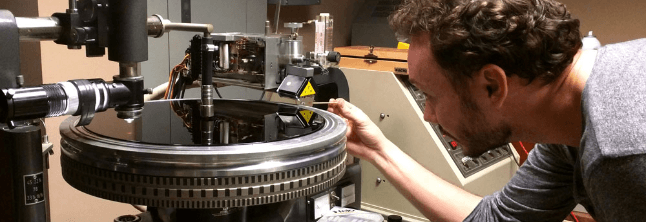
Pictured: A Neumann cutting lathe used to make the record master. Picture courtesy of Bakery Mastering

This is one of the best non-mathematical introductions to the RIAA disc recording playback chain written.

Galo worked at the Crane School of Music in New York for 30 years as an audio engineer, where he also received a Bachelor of Music in Music Education in 1973 and, in 1974, a Master of Arts in Music History. He has contributed many technical articles to professional and DIY audio publications.  

Disc Recording Equalization Demystified

(Image of RIAA EQ process above by Andrew C. Russell)

Comments

4 responses to “Disc Recording Equalization Demystified by Gary A. Galo”

  1. bonsai avatar

    Gary, apologies for that – I will correct the spelling. The illustration is mine and is from an article I wrote about equalisation elsewhere on my website.

  2. Gary A. Galo avatar
    Gary A. Galo

    My name is misspelled repeatedly throughout this page. In addition, the red, green and purple illustration, above, is not mine.

  3. Bonsai avatar

    I make it clear in the article that the pickup is a velocity transducer. However, RIAA EQ splits the audio band into 3 major sections with the mid band section from 500 Hz to 2.12 kHz encoded as constant amplitude. That means the grove displacement is cut at -20 dB/decade in this frequency band and that’s done to make sure that the stylus displacement at the frequency extremes falls within mechanical limits to allow about 20-30 minutes of time on each half of an LP.

  4. André avatar
    André

    Hello
    You mention Gary Gallo, and yes indeed his introduction is very good, but not good enough,
    because the picture above is wrong!
    The purple signal level is not on the groove, it is the equalisation applied during recording.
    But don’t worry, 99% of all the people are wrong.
    You all don’t know, that the cutter and the cartridge are velocity transducers, and theses are not linear,
    but have 6db cut (cutter) or 6db rise (cartridge) per octave.
    This is not the place for a lengthy explanation, but read Gallo carefully and remove this picture.

Leave a Reply

Your email address will not be published. Required fields are marked *


This site uses Akismet to reduce spam. Learn how your comment data is processed.